

Enterprise Business Card Ordering Approvals
Compare connected BCM approval workflows with email review. Define decision authority, preserve the approved specification, handle changes and delegation, and link authorization to the final order.
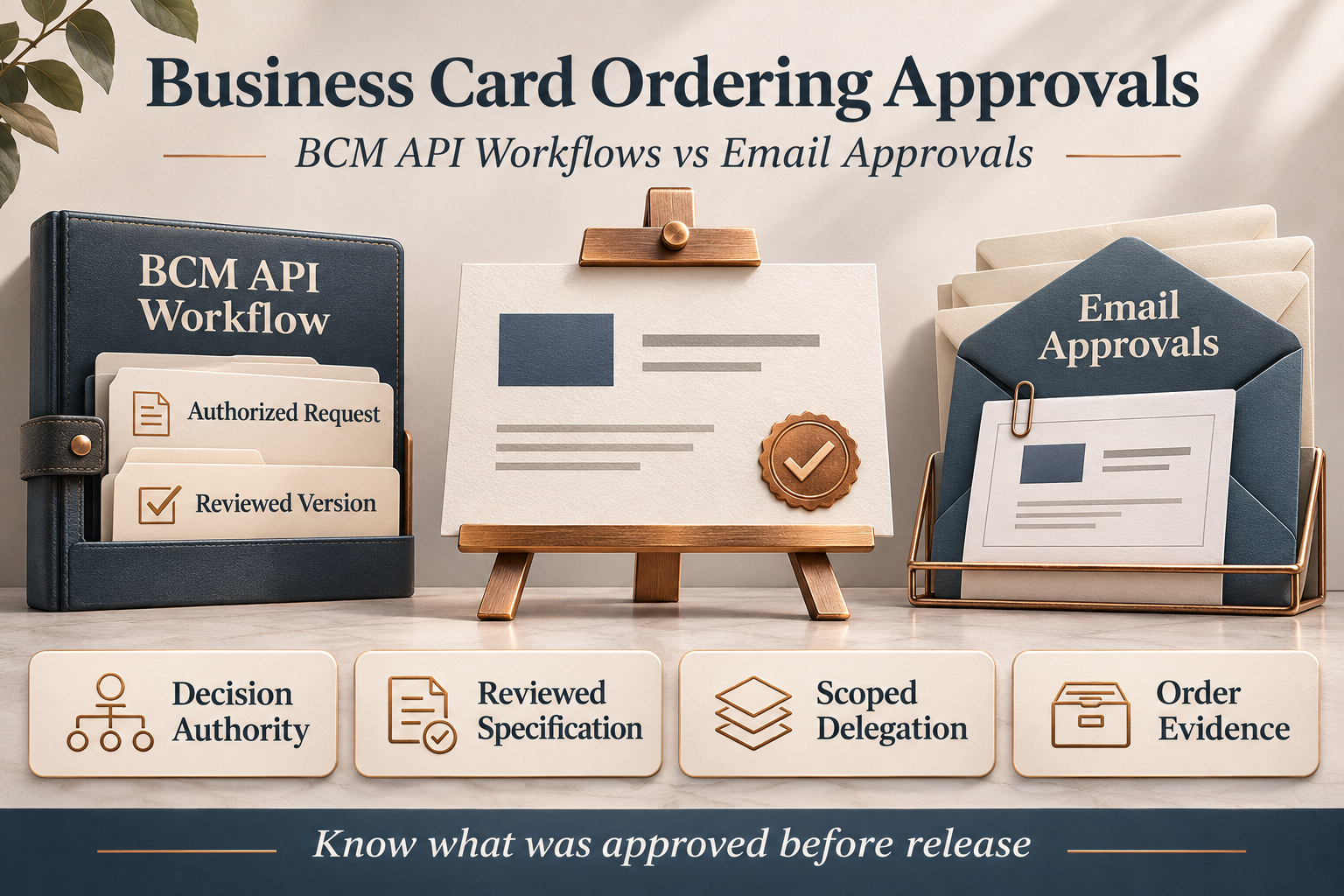
BCM (Business Card Manager) is the enterprise business card ordering management system and contracted business card vendor that converts authorized specifications into controlled orders. Enterprise business card ordering approvals establish who can authorize the identity, quantity, cost, and delivery conditions of a purchase. The practical buying question is whether a scoped BCM API workflow can make those decisions easier to operate and verify than email approvals.
An approval process succeeds when the person releasing the order can identify what was authorized, by whom, and whether that decision still applies. A message saying approved may be sufficient within a carefully defined manual process. It becomes ambiguous when the request changes, the approver moves roles, or an administrator applies the same reply to several different purchases.
This article compares connected approval workflows with email-based review through the point of order release. It focuses on approval scope, changed requests, delegation, and evidence. The controls described are buyer requirements and proposed implementation practices. Confirm available BCM operations, customer application capabilities, and deployment responsibilities before assuming any particular approval behavior is standard.
Define the Decision Behind Each Approval
Begin with the question an approver must answer. A manager may establish business need or permitted quantity. An identity owner may approve a public title. Finance may authorize an exceptional charge. A coordinator may confirm an office delivery arrangement without having authority to change the brand or spending limit.
Combining those questions into one generic approval can conceal missing authority. A manager’s agreement that an employee needs cards does not necessarily authorize a nonstandard company identity or premium product. Conversely, brand approval of the artwork does not establish that the purchasing budget is available.
Document the decisions required for the actual program, including who owns each rule and when review is unnecessary because an existing policy already covers the transaction. BCM’s implementation guidance separates employee, manager, brand, HR, finance, and administrative responsibilities and calls for scoped authority. Use that distinction to build an approval model appropriate to the purchase rather than sending every request through the same chain.
Read the enterprise BCM implementation guide
Compare the Complete Approval Operating Model
Email approvals can be practical for occasional requests with stable specifications and clear ownership. The administrator can assemble the request, send it to the authorized reviewer, retain the response, and verify that the final order matches. The work becomes harder when approvals are forwarded, attachments change, or several people answer different questions in the same thread.
A connected workflow can associate the decision with a defined request and pass the permitted result toward BCM through supported operations. Its value depends on the quality of the authority rules, the approved information retained, and the handling of exceptions. An API call does not create approval authority merely because the receiving system accepts it.
| Buying criterion | Scoped BCM API workflow | Controlled email approvals |
|---|---|---|
| Authority | Apply agreed decision scopes | Check reviewer authority for the request |
| Specification | Link decision to reviewed version | Retain reviewed content with the reply |
| Changed request | Revalidate affected decisions | Obtain revised approval where needed |
| Delegation | Check action scope and dates | Verify the current delegation record |
| Waiting work | Track owner and outstanding question | Maintain a controlled follow up register |
| Order evidence | Associate authorization with order | Match retained approval to final purchase |
Evaluate both methods against identical cases. Include an ordinary reorder, an unusual quantity, a delegated decision, a changed title, and a response received after the request was withdrawn. Ask the operator to show the final approved specification and explain why it may proceed. A fast notification alone provides little evidence of a controlled purchasing decision.
Keep Public Identity Authority Distinct From Purchasing Approval
The employee’s workforce record helps establish who the person is and where they work. It may not define every value approved for external publication. An internal role name, credential, translated title, or office address can require a separate policy decision before it appears on a physical card.
Where Color Card Administrator is deployed, CCA governs approved public identity and related exceptions. BCM acts as the conversion and execution system for the authorized business card order. The customer retains ownership of its internal workforce, purchasing, and brand policies. The approval design should make those responsibilities understandable to administrators and reviewers.
BCM’s HCM and CRM integration model describes source information and identity authority as distinct inputs to controlled ordering. Apply that separation to the approval screen or email request. Present the information needed for the reviewer’s decision and identify which values have already been approved by another authority. Avoid inviting a reviewer to edit fields they are only authorized to inspect.
Review BCM ordering governance
Show the Exact Request Being Authorized
An approver needs a stable description of the proposed transaction. Establish which details must be visible: beneficiary, purpose, public identity or proof reference, template, quantity, cost allocation, delivery conditions, and any exception requiring a decision. The necessary level of detail depends on the approval question and the enterprise policy.
Record the specification version or another reliable reference that connects the decision to the reviewed content. A hyperlink to a changing employee profile is insufficient if the earlier approved values cannot later be established. The reviewer should know whether they are approving the displayed request or a broader campaign under a defined limit.
For email review, preserve the relevant attachment or request snapshot with the response and associate it with the eventual order. For the connected option, demonstrate that the decision still points to the reviewed specification after the employee profile changes. The practical test is whether someone investigating the purchase later can explain what the approver actually saw.
Establish What Happens When Approved Details Change
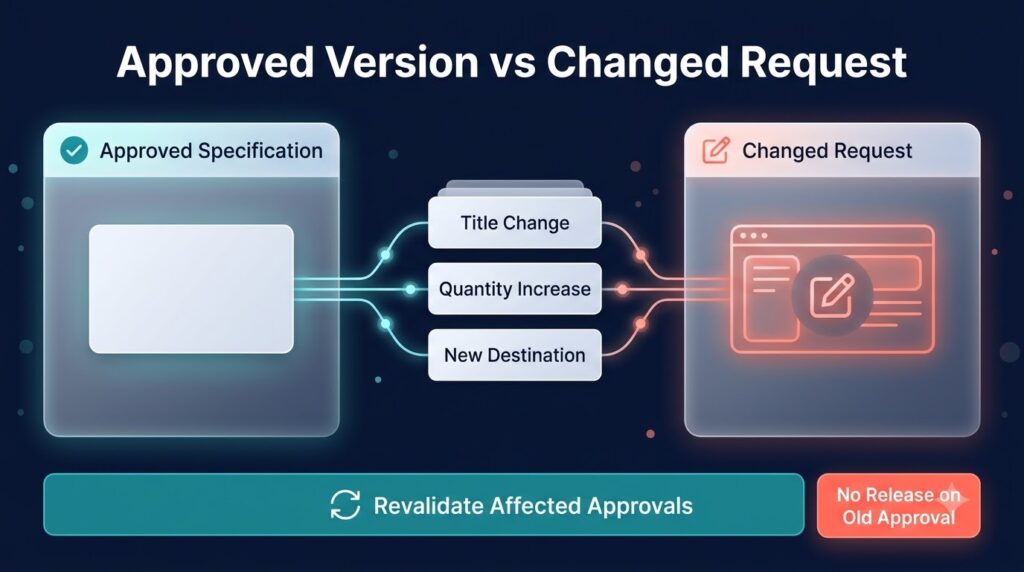
A request can change after review. The employee may correct a title, the coordinator may increase the quantity, or the destination may move from an office to another permitted address. Some changes affect only one decision; others alter the basis for several approvals.
Define material changes in relation to the authority involved. A quantity increase may require purchasing review while leaving the approved identity intact. A different legal entity or card template may require a fresh identity decision. The workflow should establish whether to preserve unaffected approvals, reopen specific reviews, or restart the entire decision under the agreed policy.
Ask for a demonstration in which a proof is approved and a material field changes before release. The operator should see the updated request and the status of the earlier decision. The email alternative needs an explicit revised request and renewed authorization where required. Neither method should silently treat an old approval as permission for a different purchase.
Scope Delegation to the Decision and Population
Absence coverage is necessary, but convenience should not create unlimited approval authority. Define who can delegate, the actions covered, the employee population or business unit involved, and the period during which the delegate may act. Include a revocation route when coverage ends earlier than expected.
A delegate may be authorized to approve ordinary quantities for one department while being unable to approve premium products or requests for another entity. The ordering process should distinguish acting for an employee from approving that employee’s purchase. An assistant’s permission to submit a request does not automatically establish authority to authorize it.
Test a delegate whose coverage has expired and another whose population scope excludes the beneficiary. A connected workflow should apply the agreed decision rules using the customer’s available capabilities. A manual process should give the administrator a current delegation record to check. In both cases, retain the acting person and the basis of their authority with the decision.
Handle Absence and Escalation Without Inventing Consent
Requests can wait because an approver is unavailable, the routing information is wrong, or a substantive question remains unresolved. These conditions need different responses. A reminder may help an absent reviewer; it will not settle a disputed title or establish a missing budget owner.
Define escalation as a transfer of responsibility to an authorized person, or as a request for intervention by the service owner. Do not treat elapsed time or silence as approval unless an explicit enterprise rule authorizes that decision for the relevant request. A deadline is a reason to resolve the case, not evidence that the purchase was accepted.
Require the proposed workflow to show the age, current owner, and outstanding question for a waiting request. Email processes can use a controlled register for the same purpose. Compare how much staff effort is required to locate stalled work and how reliably the team can distinguish a missed notification from a decision that needs additional information.
Give Rejection and Correction Different Outcomes
An approver may reject the purchasing need, request a smaller quantity, or return an incorrect detail for correction. These decisions should not all become a generic closed status. The employee needs to understand whether the request has ended or whether action can make it eligible for review again.
Define the permitted next step and the authority required for resubmission. A corrected request may need a new identity review but retain an unaffected business-need decision. A rejected exceptional cost should not be bypassed by resubmitting the same purchase under a different subject line or through another channel.
Use a case where an employee receives a return-for-correction decision and later submits through a second entry point. Ask how the operator identifies the relationship and applies the relevant policy. The objective is a consistent decision trail, not a blanket prohibition on every later legitimate request by the same employee.
Connect Approval Evidence to the Order Release
The approval record and the BCM order should be linked through reliable references. Identify which customer application holds the decision history and how the ordering process establishes that the required decisions cover the specification being submitted. A copied approved flag can be misleading when its scope and version are missing.
The integration design should also distinguish an approval decision from technical handling and order acceptance. A successful transfer can confirm that information reached a boundary without establishing that every business requirement is satisfied. BCM’s published integration model explicitly separates a source signal or request from authorization to release production.
Test a request that passes customer approval but fails a later validation or has an uncertain submission outcome. The service team should be able to investigate through supported records or an agreed BCM route before retrying. Approval is permission for the defined purchase; it is not proof that an order exists or that a second purchase is safe.
Explore the BCM HCM and CRM integration model
Choose the Customer Application Role Before Defining the API Connection
ServiceNow may provide the employee request and service conversation. Dynamics 365 or HubSpot may contribute limited commercial context. Workday, SAP SuccessFactors, Oracle HCM, ADP, UKG, or Dayforce may supply workforce facts and reporting relationships. Microsoft Entra ID may contribute approved directory or access information. Establish the actual authority of each source before using it to route an approval.
A reporting manager in one application is not automatically the correct purchasing approver for every legal entity, budget, or exception. Confirm how missing relationships, temporary assignments, and matrix reporting are handled. Avoid copying a hierarchy into approval routing without testing whether it represents the enterprise’s purchasing policy.
Confirm customer product access, licenses, available BCM operations, and implementation ownership. A proposed architecture does not establish a native BCM connector or a universal approval endpoint. Where Business Ops Center is deployed for cross-system oversight, define its responsibility for coordination and unresolved work while retaining CCA’s identity authority and BCM’s order execution role.
Explore BCM integration options
Preserve Evidence Without Exposing Unnecessary Information
Keep enough evidence to establish the actor, decision, authority, reviewed specification, time, and resulting order relationship. Define who can inspect the decision history and how long the information needs to remain available under the enterprise’s applicable policies. Avoid using email distribution lists as a substitute for deliberate access decisions.
A manager may need to review a business purpose and quantity without seeing unrelated employee data. An integration support team may need transaction references and error details rather than a complete proof or private delivery information. Include notifications, attachments, exports, and operational logs when reviewing where approval information travels.
Evaluate how a transferred or departed approver affects historical records and current tasks. The enterprise may need to retain the earlier decision while assigning future work to a new authorized person. Removing current access should not make past purchases impossible to explain, and historical involvement should not grant continuing permission to act.
Measure Approval Quality Alongside Speed
Record the existing time spent preparing review information, chasing responses, checking authority, resolving corrections, and matching approval evidence to orders. Separate active handling from the elapsed time a request waits for a decision. A shorter notification delay does not necessarily reduce the work required to establish authorization.
Pilot the proposed design with ordinary and exceptional cases. Include a changed specification, expired delegate, missing approver, returned request, late reply, and interrupted submission. Ask the operator to reconstruct the final decision and order relationship for each case without relying on personal memory.
Compare ongoing mapping, monitoring, and support effort with the manual process. The integration is most useful when it removes repeated handling while making the decision easier to verify. Retain a documented recovery route for unavailable systems and a reconciliation step for work handled during an outage, so that continuity arrangements do not create duplicate or unauthorized purchases.
Questions About Enterprise Business Card Ordering Approvals
Does a manager approval cover every part of the order?
Only within the manager’s defined authority. Business need, public identity, exceptional cost, and delivery conditions may require different decisions. Establish the scope of each approval in the enterprise policy and implemented workflow.
Can email approvals remain a valid operating option?
They can support a controlled process when the reviewer’s authority, approved specification, response, and order relationship are retained. Compare the recurring administration and exception effort with the proposed API workflow before deciding.
Should a changed request always restart every approval?
Use the agreed materiality rules. A change may invalidate one decision while leaving another applicable. Demonstrate how the process identifies affected approvals and prevents release against an outdated specification.
Does a successful API response establish production approval?
Interpret the response according to the supported operation. Technical acceptance, business authorization, order acceptance, and production release are separate conditions. Verify the evidence required for each in the actual deployment.
What should an approval workflow demonstration prove?
It should establish who may decide, what they reviewed, how changes and delegation are handled, and how the final authorization connects to the order. Include exceptions and recovery alongside the ordinary request.
Request a BCM Approval Workflow Assessment
Bring a routine request, a request changed after approval, and an example that required delegated or exceptional authority. Ask BCM to demonstrate the supported ordering path and identify where customer applications retain decisions and enforce policy. Compare that proposal with your email process using the same approval scope and evidence requirements. Establish who owns stalled or uncertain work so that the final purchase can be explained from the reviewed request through the accepted order.
Request pricing or schedule a demo with Business Card Manager to review your approval workflow integration scope.
Discuss enterprise business card approval workflows with BCM