

Why Policy-Driven Business Card Management Is Essential for Enterprise Control
Introduction
Policies are only valuable when they are consistently applied.
Enterprises invest significant time in creating policies that govern branding, procurement, employee identity, spending authority, data accuracy, supplier selection, and compliance. Yet many of these policies remain disconnected from the daily processes through which business cards are requested, approved, produced, and distributed.
An employee may submit a business card request using outdated information.
A manager may approve a title that does not match the official HR record.
A regional office may use an obsolete template.
A local supplier may produce cards using unapproved materials.
Marketing may review artwork manually without a complete audit history.
Procurement may have no visibility into the transaction until an invoice arrives.
Each event appears minor in isolation. At enterprise scale, however, these exceptions create a fragmented operating environment in which policies exist on paper but are not reliably enforced in practice.
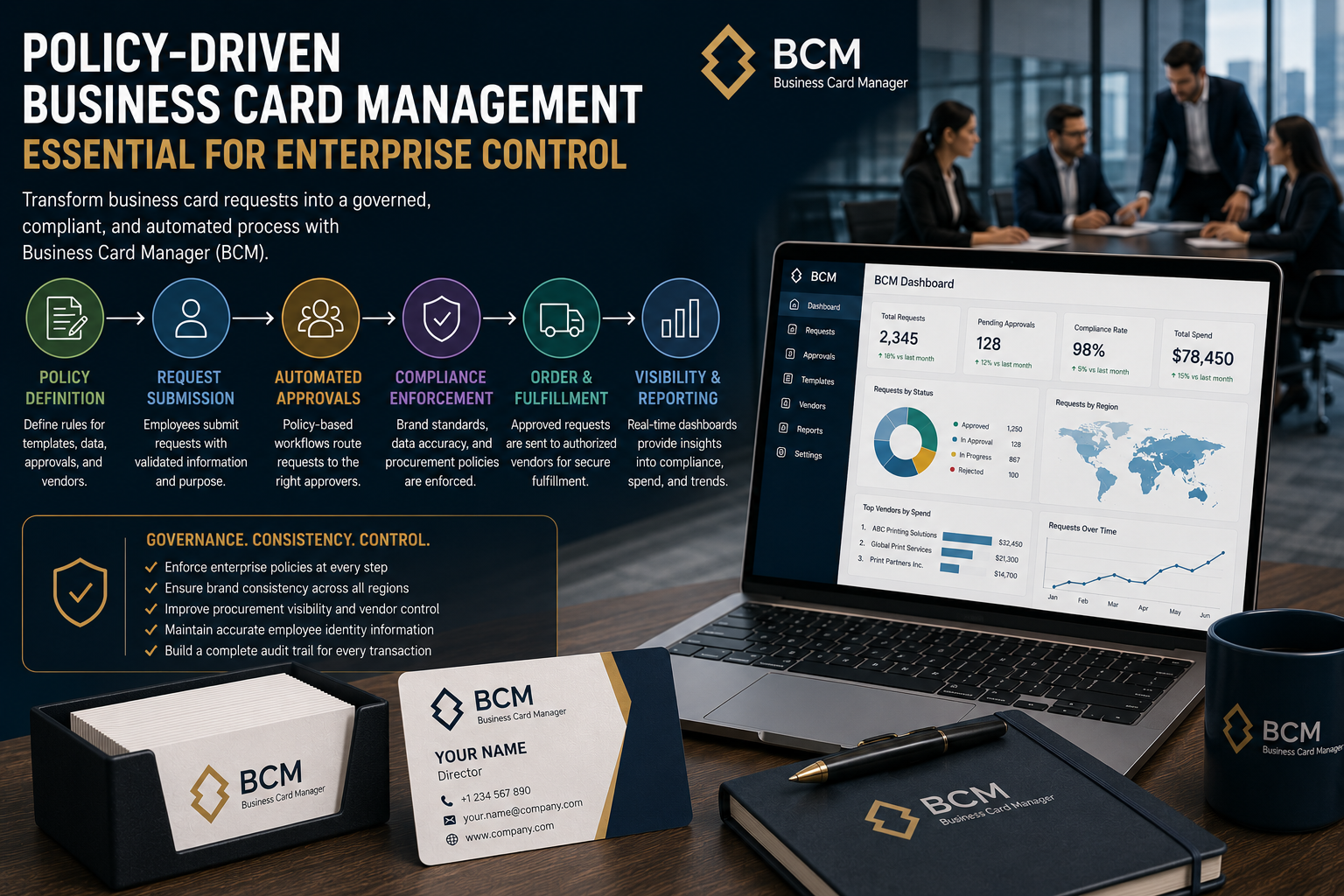
Policy-driven business card management addresses this gap by converting enterprise rules into automated controls. Instead of depending on individual interpretation, organizations can define how requests should be handled based on employee role, geography, department, brand, legal entity, cost center, and supplier policy.
Business Card Manager provides the workflow and governance infrastructure required to make those policies operational.
Business Card Governance Begins with Policy
A business card request is not simply a request for printed stationery. It is a request to create and distribute an official corporate identity asset.
That asset may include:
- Employee name
- Job title
- Department
- Office location
- Telephone number
- Email address
- Corporate logo
- Brand designation
- Legal entity information
- Regulatory statements
- Professional certifications
Every element must be accurate, approved, and aligned with organizational policy.
A policy-driven approach begins by defining the conditions under which each data element, template, approval path, and supplier can be used.
For example, an organization may require senior leadership titles to receive additional approval. Employees in regulated industries may require legal review. Regional offices may use localized templates containing country-specific legal information. Certain suppliers may be approved only for specific markets.
Without a governed platform, these rules are difficult to apply consistently. With BCM, policy becomes part of the workflow itself.
The Limitations of Manual Policy Enforcement
Many enterprises attempt to enforce business card policies through written guidelines, email instructions, shared folders, and manual review.
These methods place too much responsibility on individuals.
Employees must locate the correct template.
Managers must remember approval criteria.
Marketing must manually compare each request against brand standards.
Procurement must verify whether the selected vendor is approved.
Administrators must confirm that employee details are current.
As request volumes increase, policy enforcement becomes slower and less reliable.
Manual processes also create several structural weaknesses.
Policies Are Interpreted Differently
Different managers may apply different approval standards. Regional teams may interpret corporate branding rules in inconsistent ways. Exceptions may be approved without proper documentation.
Updates Are Difficult to Distribute
When brand standards, legal requirements, or procurement policies change, organizations must manually update templates, instructions, and supplier communications across multiple locations.
Auditability Is Limited
Email approvals and spreadsheet records rarely provide a complete view of who approved a request, which policy was applied, and what changes occurred before production.
Compliance Depends on Administrative Capacity
When teams are busy, manual checks may be skipped or performed inconsistently. Governance becomes dependent on individual attention rather than system-enforced control.
Policy-driven automation removes much of this variability.
How BCM Converts Policy into Workflow
Business Card Manager enables enterprises to define operational rules and apply them automatically throughout the business card lifecycle.
A request can be evaluated according to:
- Employee role
- Department
- Business unit
- Geography
- Legal entity
- Brand
- Cost center
- Card type
- Order quantity
- Supplier assignment
- Approval authority
The system can then route the request through the appropriate workflow.
A standard employee request may require manager approval.
An executive request may require additional brand or administrative review.
A regional template may require local legal approval.
A high-value order may require procurement authorization.
A request containing non-standard information may be flagged as an exception.
This policy-driven model improves both speed and control. Routine requests move efficiently, while higher-risk requests receive additional scrutiny.
Policy-Driven Template Governance
Templates are one of the most important control points in business card management.
When employees or regional offices maintain separate files, organizations quickly lose visibility into which versions are current. Old logos, outdated addresses, incorrect colors, and unauthorized layouts remain in circulation long after standards have changed.
BCM centralizes template governance by enabling organizations to maintain approved templates within a controlled environment.
Templates can be assigned according to:
- Country
- Region
- Brand
- Subsidiary
- Department
- Employee role
- Language
- Legal entity
This allows enterprises to support legitimate variation without sacrificing control.
A multinational organization may require different legal disclosures in each country. A multi-brand enterprise may maintain distinct visual identities. An acquired company may temporarily operate under transitional branding.
Policy-driven template governance ensures that these differences remain authorized, structured, and traceable.
Employee Data Accuracy as a Governance Requirement
Business cards often contain information that already exists within enterprise systems.
Yet many organizations require employees to re-enter that information manually.
This creates avoidable risk.
Employees may abbreviate titles differently.
Phone numbers may be entered incorrectly.
Office addresses may be outdated.
Department names may not match official records.
Certifications may be added without authorization.
BCM reduces this risk by enabling business card workflows to use approved employee data from authoritative enterprise systems such as HR platforms, corporate directories, or identity systems.
This supports a core governance principle: corporate identity information should come from trusted sources rather than uncontrolled manual entry.
Where employee edits are permitted, BCM can restrict which fields may be changed and route non-standard modifications for additional approval.
Role-Based Approval Workflows
Not every business card request requires the same level of review.
Policy-driven approval workflows allow organizations to apply the appropriate level of governance based on risk and business context.
A typical workflow may include:
- Employee submission
- Manager approval
- Marketing or brand review
- Procurement validation
- Legal review
- Vendor fulfillment
However, the actual path may vary depending on the request.
Routine orders can move quickly.
Executive titles can receive additional verification.
Regulated content can be reviewed by legal teams.
Unusual quantities can be escalated to procurement.
Exceptions can be documented and approved by authorized stakeholders.
This role-based model improves accountability because each participant is responsible only for the decisions relevant to their function.
Procurement Policy Enforcement
Business card governance also requires procurement control.
Without centralized supplier policies, regional offices may select vendors based on convenience rather than approved enterprise criteria.
This can lead to:
- Inconsistent pricing
- Variable production quality
- Duplicate supplier relationships
- Weak contract compliance
- Limited spend visibility
- Incomplete performance reporting
BCM enables organizations to assign approved vendors according to region, brand, product type, or service requirements.
Requests can be routed automatically to the correct supplier once approvals are complete.
Procurement teams gain visibility into order volume, supplier utilization, pricing, turnaround time, and service performance.
This transforms business card purchasing from a series of isolated transactions into a governed procurement process.
Managing Exceptions Without Losing Control
Effective governance should not eliminate all flexibility.
Enterprises regularly encounter legitimate exceptions.
An executive may require a non-standard title presentation.
A regional office may need a temporary address.
A newly acquired company may require transitional branding.
A customer-facing employee may need bilingual information.
The goal is not to prevent every exception. The goal is to ensure exceptions are visible, authorized, and documented.
BCM supports exception governance by routing non-standard requests through additional review steps.
This creates a controlled path for flexibility while preserving enterprise oversight.
Instead of employees bypassing the system, they can submit exceptions within the governed workflow.
Auditability and Compliance Readiness
One of the strongest benefits of policy-driven business card management is the creation of a complete audit trail.
Organizations can maintain records of:
- Request submission
- Employee information used
- Template selected
- Approval decisions
- Policy exceptions
- Vendor assignment
- Production status
- Delivery confirmation
- Changes made during review
This information supports internal audits, compliance reviews, procurement analysis, and operational improvement.
More importantly, it enables the organization to demonstrate that business card processes are governed rather than informal.
For enterprises operating in regulated industries or complex global environments, that distinction is increasingly important.
Policy-Driven Governance Improves Employee Experience
Governance is sometimes perceived as an obstacle to speed.
In practice, poorly designed manual governance causes far more delay than well-designed automation.
Employees become frustrated when they do not know which template to use, who must approve the request, or when the cards will arrive.
BCM improves the employee experience by providing a clear, structured process.
Employees can submit requests through a standardized interface.
Approved information can populate automatically.
The correct workflow can be selected based on policy.
Status updates can be provided throughout the process.
Routine requests can move faster because fewer manual checks are required.
Policy-driven automation therefore improves both governance and usability.
Executive Visibility and Governance Analytics
Enterprise policies should produce measurable outcomes.
BCM provides reporting capabilities that help leadership evaluate whether business card governance is working as intended.
Organizations can monitor:
- Approval turnaround time
- Policy exception volume
- Vendor utilization
- Orders by region
- Orders by department
- Template adoption
- Procurement spend
- Compliance rates
- Reorder patterns
These insights allow leaders to identify bottlenecks, supplier issues, policy weaknesses, and opportunities for automation.
Governance becomes a continuous improvement discipline rather than a one-time implementation exercise.
Supporting Organizational Change
Policy-driven business card management becomes especially valuable during major organizational events.
These include:
- Mergers and acquisitions
- Brand refreshes
- Office relocations
- Legal entity changes
- Corporate restructuring
- Global expansion
- Regulatory updates
Such events may require thousands of business cards to be updated within a short period.
Without centralized governance, organizations must coordinate changes across multiple departments, suppliers, and regional offices.
BCM provides a controlled operating model through which templates, policies, approval paths, and supplier assignments can be updated centrally.
This improves speed while reducing the risk of inconsistent rollout.
BCM as the Enterprise Conversion Engine
Within the broader enterprise governance ecosystem, BCM serves as the conversion engine that transforms approved identity information and policies into compliant, customer-facing business cards.
CCA acts as the authority engine by governing identity, approvals, and brand standards.
BOC provides broader operational governance and workflow visibility.
BCM converts those approved rules and identity decisions into an operational output that employees can use in real customer and partner interactions.
This distinction is important.
BCM is not merely a design or printing application. It is the execution layer through which enterprise identity policy becomes a controlled physical asset.
Conclusion
Enterprise policies create value only when they are consistently applied.
Business card management touches branding, procurement, employee identity, compliance, vendor management, and customer experience. Managing these activities through email, spreadsheets, local files, and manual review creates unnecessary operational risk.
Policy-driven business card management provides a stronger model.
Business Card Manager enables organizations to embed rules directly into workflows, ensuring that every request follows the correct approval path, uses the appropriate template, relies on trusted employee information, and reaches an approved supplier.
The result is greater consistency, stronger compliance, improved procurement visibility, faster processing, and better executive oversight.
For modern enterprises, business card governance should not depend on individual interpretation.