

Enterprise Identity Governance Metrics: Measuring Business Card Operations For Continuous Improvement
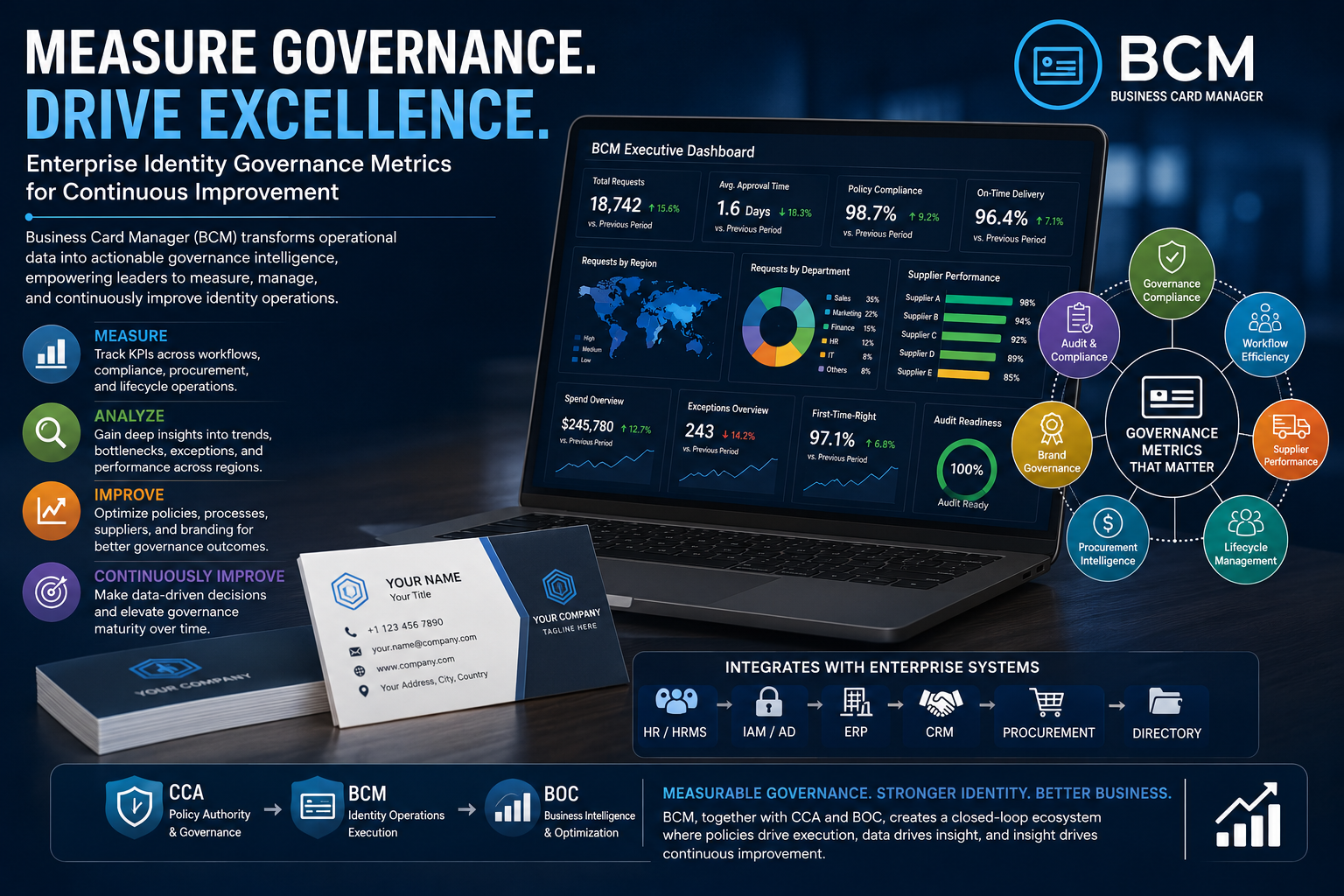
hichEnterprise governance cannot be improved unless it can be measured.
While organizations invest heavily in governance frameworks, workflow automation, identity management, procurement systems, and digital transformation initiatives, many still struggle to answer fundamental operational questions.
- Are governance policies actually being followed?
- Which business units experience the highest approval delays?
- Which suppliers consistently meet enterprise expectations?
- How often are policy exceptions occurring?
- Which regions generate the highest operational costs?
- Are executive governance initiatives producing measurable business value?
Without objective measurements, governance becomes dependent upon assumptions rather than operational evidence.
This challenge is particularly evident within enterprise identity operations.
Business card management may appear to be a relatively small operational process, but it represents a critical intersection of employee identity, corporate branding, procurement, workflow governance, compliance, supplier management, and customer experience.
Every business card issued by an enterprise represents an officially approved organizational identity.
Consequently, every request, approval, production activity, supplier interaction, delivery confirmation, replacement, and retirement event produces valuable operational intelligence.
Business Card Manager (BCM) transforms these operational events into measurable governance metrics that enable executives to understand not only what has happened, but why it happened, where improvements are required, and how governance maturity evolves over time.
Within the enterprise ecosystem, Color Card Administrator (CCA) establishes governance authority and enterprise policies, Business Card Manager (BCM) converts approved policies into governed operational execution, while Business Operations Center (BOC) aggregates operational intelligence into executive dashboards supporting enterprise decision-making.
Together, these platforms establish a measurable governance framework where policy execution continuously feeds executive insight, enabling organizations to improve operational performance through evidence-based decision-making rather than subjective observation.
Why Governance Must Be Measurable
Many organizations mistakenly assume that implementing workflows automatically results in improved governance.
Automation certainly increases operational efficiency.
However, efficiency alone does not demonstrate governance effectiveness.
Consider two organizations.
Process approximately 15,000 business card requests annually.
Have automated workflows.
Maintain standardized templates.
At first glance, their operations appear equally mature.
However, detailed measurement reveals significant differences.
One organization maintains:
- 99% policy compliance
- 98% supplier SLA achievement
- Executive approval completion within two days
- Minimal exception requests
- Consistent regional branding
- Complete audit documentation
The second organization experiences:
- Frequent policy overrides
- Regional inconsistency
- Procurement duplication
- Supplier performance variation
- Manual intervention
- Delayed executive approvals
- Increasing operational costs
Without enterprise metrics, these differences remain invisible.
Governance therefore requires measurable operational indicators that reveal not only workflow activity but also governance quality.
BCM provides this visibility through comprehensive enterprise analytics that extend across the complete identity lifecycle.
Moving Beyond Operational Reporting
Traditional reporting focuses primarily on historical activities.
Typical reports answer questions such as:
- How many business cards were printed?
- Which departments submitted requests?
- Which suppliers fulfilled orders?
- How much money was spent?
Although useful, these reports offer limited strategic value.
Enterprise governance requires analytical reporting capable of explaining operational behavior.
Why are approval times increasing?
Which regions require additional governance training?
Why do suppliers consistently outperform competitors?
Which business units generate excessive policy exceptions?
How effectively are procurement contracts being utilized?
How quickly are new employees receiving approved identity assets?
Which offboarding policies are being enforced?
These questions move beyond transaction reporting into enterprise governance intelligence.
BCM therefore transforms operational data into executive insight by connecting workflows, business card procurement, compliance, supplier management, lifecycle events, and governance policies within a single analytical framework.
Enterprise Identity Operations as a Measurable System
Every governed identity operation produces measurable information.
For example, a seemingly simple business card request generates numerous governance events:
- Employee eligibility verification
- Manager approval
- Department approval
- Marketing validation
- Regional policy evaluation
- Template validation
- Supplier selection
- Production scheduling
- Delivery confirmation
- Audit logging
- Lifecycle synchronization
- Operational reporting
Rather than viewing these activities independently, BCM treats each event as part of an integrated governance system.
This approach allows executives to observe operational patterns across thousands of requests rather than analyzing isolated transactions.
Over time, trends become increasingly valuable.
Executives can identify:
- Seasonal workload fluctuations.
- Departments requiring workflow optimization.
- Regions generating high operational costs.
- Policy exceptions becoming increasingly common.
- Supplier performance improvements.
- Brand consistency trends.
- Compliance maturity.
- Governance effectiveness.
Instead of reacting to operational issues after they occur, enterprises begin managing governance proactively.
Characteristics of Effective Governance Metrics
Not every operational measurement contributes to better governance.
Effective enterprise metrics possess several important characteristics.
Alignment with Business Objectives
Every KPI should support broader enterprise objectives rather than measuring activity for its own sake.
For example:
- Average approval time contributes to employee onboarding efficiency.
- Supplier performance contributes to procurement optimization.
- Policy compliance contributes to regulatory governance.
- Brand consistency contributes to customer trust.
Executive dashboards should therefore connect operational performance directly with organizational objectives.
Actionable Insights
Measurements should encourage decision-making.
A dashboard showing that 18,000 business cards were printed during the previous quarter provides historical information.
However, a dashboard indicating that approval delays increased by 27% following organizational restructuring immediately suggests an operational improvement opportunity.
Actionable metrics support governance decisions rather than simply documenting operational history.
Enterprise Comparability
Large organizations require standardized identity execution metrics capable of comparing operational performance across:
- Business units
- Countries
- Regions
- Legal entities
- Suppliers
- Departments
- Management structures
Without standardized measurement definitions, enterprise benchmarking becomes unreliable.
BCM therefore applies consistent KPI definitions across the organization while supporting regional reporting requirements where appropriate.
Continuous Measurement
Governance should not be evaluated annually.
Instead, enterprise metrics should be collected continuously.
Real-time dashboards allow leadership teams to monitor governance performance as organizational conditions evolve.
This continuous visibility enables rapid identification of:
- Emerging workflow bottlenecks.
- Supplier performance deterioration.
- Increasing policy exceptions.
- Regional governance risks.
- Compliance concerns.
- Operational improvements.
By monitoring governance continuously rather than periodically, organizations significantly improve operational responsiveness.
Building an Enterprise KPI Framework
An effective governance dashboard balances operational efficiency with strategic oversight.
BCM organizes enterprise metrics into several complementary categories that together provide a comprehensive understanding of identity operations.
These categories include:
- Governance Performance
- Workflow Efficiency
- Procurement Intelligence
- Supplier Performance
- Brand Governance
- Compliance Monitoring
- Employee Lifecycle Metrics
- Executive Performance Indicators
- Continuous Improvement Analytics
Each category measures a different aspect of enterprise identity governance while collectively providing leadership with a complete operational picture.
Unlike isolated reports, this integrated KPI framework enables executives to understand how governance decisions influence procurement efficiency, employee experience, regulatory compliance, supplier performance, and overall organizational effectiveness.
Building a Comprehensive Enterprise Governance KPI Framework
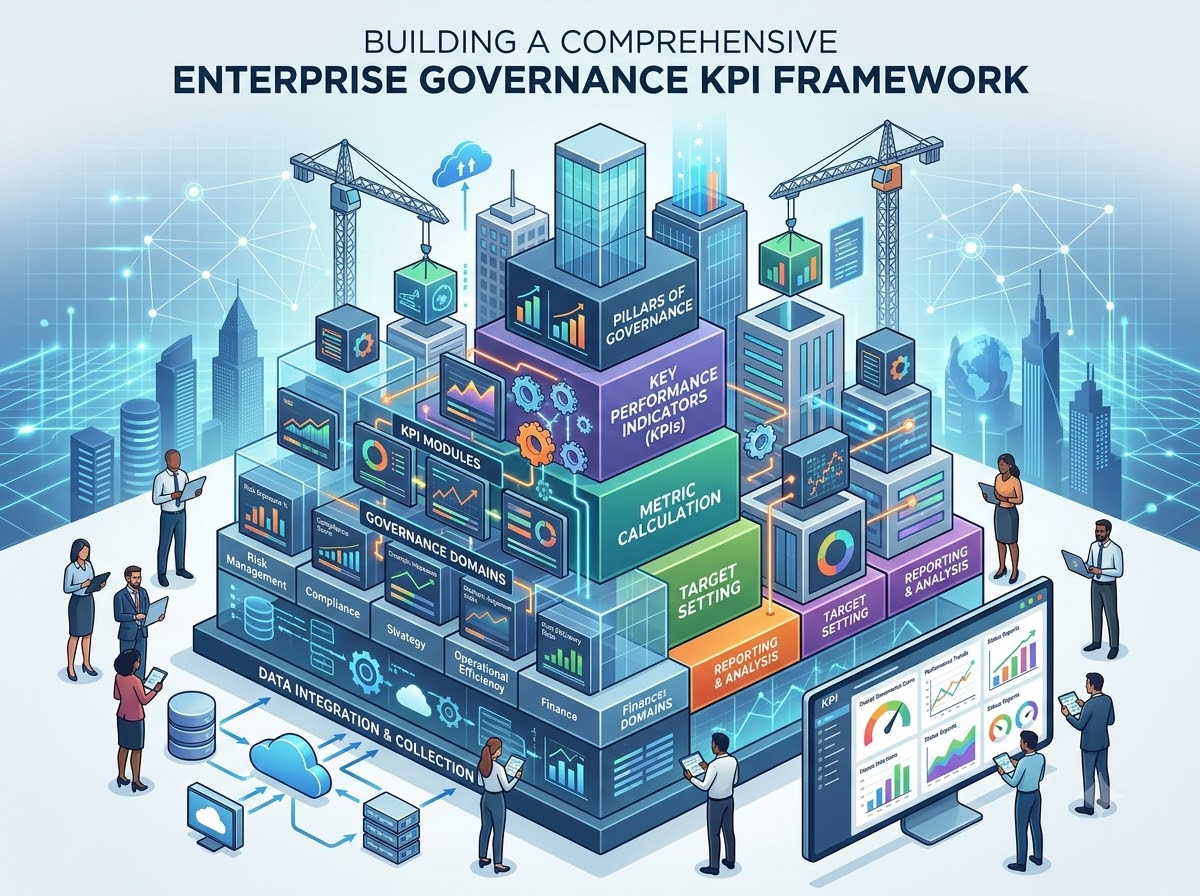
An enterprise governance framework is only as effective as its ability to measure performance consistently across business units, regions, suppliers, and operational processes.
Business Card Manager (BCM) transforms operational data into structured governance intelligence by organizing performance indicators into logical categories that reflect enterprise objectives rather than isolated operational activities.
Instead of relying on disconnected reports generated by different departments, executives gain access to a unified governance model where every operational metric contributes to a broader understanding of organizational performance.
This integrated approach enables leadership teams to evaluate business card operations as part of enterprise decision governance rather than as a standalone administrative function.
Governance Performance Indicators
Governance metrics evaluate how effectively enterprise policies are executed throughout the organization.
Unlike operational statistics, governance indicators focus on policy adherence, decision quality, and organizational consistency.
Policy Compliance Rate
This KPI measures the percentage of requests completed without violating established enterprise policies.
Consistently high compliance indicates that governance policies are well understood, effectively communicated, and properly enforced.
Unexpected decreases may suggest:
- Organizational restructuring
- Policy ambiguity
- Insufficient training
- Regional inconsistencies
- Workflow configuration issues
Monitoring policy compliance over time allows governance teams to identify areas requiring corrective action before they become enterprise-wide risks.
Approval Effectiveness
Approval workflows exist to ensure that identity decisions align with organizational governance.
Important measurements include:
- Average approval duration
- Percentage of automated approvals
- Approval rejection rates
- Escalation frequency
- Executive intervention requirements
Rather than measuring approval speed alone, BCM evaluates whether approval processes remain aligned with enterprise governance objectives.
Fast approvals without governance discipline create operational risk.
Excessively slow approvals reduce organizational agility.
Effective governance balances both.
Policy Exception Trends
Exceptions are inevitable within global enterprises.
However, increasing exception rates often indicate underlying governance weaknesses.
BCM continuously monitors:
- Number of exception requests
- Exception categories
- Business units generating exceptions
- Regional patterns
- Executive approval frequency
- Exception resolution time
Trend analysis enables governance committees to determine whether policies require refinement or whether organizational compliance requires improvement.
Executive Governance Dashboards
Enterprise executives require summarized operational intelligence rather than detailed transactional reports.
Business Card Manager therefore provides governance dashboards tailored to executive decision-making.
These dashboards present information through strategic perspectives rather than operational detail.
Typical executive dashboard components include:
Enterprise Governance Score
A composite indicator representing overall governance maturity.
The score combines:
- Policy compliance
- Workflow performance
- Procurement consistency
- Supplier quality
- Audit readiness
- Brand compliance
- Lifecycle governance
This single metric enables leadership to monitor enterprise governance health over time.
Regional Governance Comparison
Global enterprises frequently experience operational variation between geographic regions.
BCM allows executives to compare:
- Compliance rates
- Processing efficiency
- Supplier performance
- Operational costs
- Policy exceptions
- Branding consistency
Benchmarking encourages knowledge sharing between regions while identifying operational improvement opportunities.
Organizational Heat Maps
Visual heat maps quickly identify areas requiring executive attention.
Heat maps may highlight:
- Approval bottlenecks
- High-cost regions
- Supplier performance concerns
- Compliance risks
- Departments with elevated exception rates
Rather than reviewing hundreds of reports, executives immediately understand where governance intervention is required.
Procurement Intelligence
Business card operations generate valuable procurement information that extends beyond individual purchase orders.
Every transaction contributes to enterprise sourcing intelligence.
BCM continuously evaluates procurement activities including:
- Total enterprise spend
- Spend by supplier
- Spend by region
- Cost per business card
- Contract utilization
- Vendor concentration
- Procurement cycle time
These insights help procurement teams negotiate better supplier agreements while improving overall operational efficiency.
Cost Optimization Opportunities
Procurement analytics identify opportunities such as:
- Supplier consolidation
- Contract renegotiation
- Volume discounts
- Regional sourcing optimization
- Shipping efficiency
- Inventory reduction
Rather than focusing solely on reducing costs, BCM supports procurement decisions that balance financial performance with governance quality and service reliability.
Supplier Performance Scorecards
Approved suppliers play a critical role within enterprise identity operations.
Their performance directly influences governance consistency, customer experience, and organizational reputation.
BCM evaluates supplier performance across multiple dimensions.
Operational Performance
Measurements include:
- Order accuracy
- Production quality
- Delivery reliability
- SLA compliance
- Defect rates
- Rework frequency
Governance Performance
Beyond operational efficiency, BCM evaluates suppliers based on governance expectations.
Examples include:
- Template compliance
- Brand accuracy
- Regulatory adherence
- Security requirements
- Contract compliance
- Audit cooperation
These governance-focused measurements help enterprises retain suppliers that consistently support long-term operational objectives.
Continuous Supplier Improvement
Historical performance enables procurement teams to identify:
- Improving suppliers
- Declining suppliers
- Training opportunities
- Contract renewal decisions
- Risk mitigation priorities
Instead of making procurement decisions based solely on price, organizations evaluate suppliers using comprehensive operational evidence.
Brand Governance Metrics
Business identity represents one of the most visible aspects of corporate governance.
Brand inconsistency may damage customer confidence while reducing organizational credibility.
BCM continuously measures brand governance through indicators including:
- Approved template utilization
- Unauthorized template requests
- Regional branding consistency
- Logo compliance
- Typography compliance
- Language compliance
- Regulatory disclaimer accuracy
These metrics ensure that every employee-facing identity asset reflects approved corporate standards.
Template Lifecycle Analytics
Brand assets evolve continuously.
BCM monitors:
- Active template versions
- Template retirement
- Regional adoption
- Legacy template usage
- Migration progress
This visibility enables marketing and governance teams to coordinate enterprise-wide branding initiatives with minimal operational disruption.
Compliance and Audit Reporting
Audit readiness is a critical component of enterprise governance.
Business Card Manager automatically records every significant operational event throughout the identity lifecycle.
Audit reporting includes:
- Request history
- Approval records
- Identity changes
- Policy evaluations
- Supplier selection
- Production confirmation
- Delivery verification
- Exception approvals
- Administrative actions
Comprehensive audit documentation reduces preparation time during regulatory reviews while improving organizational transparency.
Compliance Dashboards
Compliance officers benefit from dashboards summarizing:
- Outstanding policy violations
- Audit completion status
- Regulatory exceptions
- Governance trends
- Regional compliance performance
These dashboards allow governance teams to identify emerging risks before they affect regulatory obligations.
Identity Lifecycle Analytics
Identity governance extends beyond the initial business card request.
BCM continuously measures activities throughout the employee lifecycle.
Important lifecycle metrics include:
Onboarding
- Time from hiring to request initiation
- Approval duration
- Production completion
- Delivery confirmation
Organizational Changes
- Promotions
- Department transfers
- Regional relocations
- Corporate restructuring
BCM measures how efficiently updated identity assets are provided following organizational changes.
Offboarding
Effective governance requires timely retirement of identity assets.
Metrics include:
- Business card deactivation
- Outstanding inventory
- Pending requests
- Compliance completion
These measurements help ensure that former employees no longer represent the organization using outdated identity materials.
The CCA–BCM–BOC Intelligence Model
The greatest value of enterprise analytics is achieved when governance platforms operate together.
Within the integrated governance architecture:
Color Card Administrator (CCA)
CCA establishes governance authority.
It defines:
- Enterprise policies
- Approval structures
- Identity standards
- Organizational rules
- Brand governance
Business Card Manager (BCM)
BCM executes governed operations.
It measures:
- Workflow performance
- Identity lifecycle
- Procurement execution
- Supplier coordination
- Compliance activities
Business Operations Center (BOC)
BOC transforms operational data into executive intelligence.
It provides:
- Enterprise dashboards
- KPI monitoring
- Trend analysis
- Governance maturity reporting
- Executive scorecards
- Continuous improvement recommendations
Together, these three platforms establish a closed-loop governance ecosystem where:
- Policies become workflows.
- Workflows generate measurable operational data.
- Operational data becomes executive intelligence.
- Executive intelligence continuously improves enterprise governance.
This integrated architecture ensures that governance is not merely implemented—it is continuously measured, evaluated, refined, and strengthened across the enterprise.
AI-Powered Governance Analytics: From Measurement to Prediction
Enterprise analytics has traditionally focused on historical reporting. Organizations collected operational data, produced dashboards, reviewed performance during monthly meetings, and implemented corrective actions after issues had already affected business operations.
Modern enterprise governance requires a fundamentally different approach.
Rather than simply reporting what happened, organizations increasingly expect analytics platforms to explain why it happened, predict what is likely to happen next, and recommend appropriate actions before operational risks materialize.
Business Card Manager (BCM) represents the evolution from descriptive reporting to intelligent governance analytics.
When integrated with Color Card Administrator (CCA) and Business Operations Center (BOC), BCM becomes part of a continuously learning governance ecosystem capable of supporting enterprise-wide operational excellence.
Artificial Intelligence should never replace enterprise governance. Instead, it should strengthen governance by providing decision-makers with earlier visibility, richer operational context, and more informed recommendations.
Examples of AI-assisted capabilities include:
- Predicting approval bottlenecks before service levels decline.
- Identifying departments with increasing policy exception trends.
- Forecasting business card governance demand based on hiring patterns.
- Detecting unusual ordering behavior that may indicate policy violations.
- Recommending optimal suppliers using historical delivery and quality performance.
- Highlighting regions where governance maturity is declining.
- Identifying recurring operational inefficiencies requiring process redesign.
These insights enable organizations to move from reactive management toward proactive governance.
Predictive Operational Intelligence
Enterprise identity operations generate thousands of governance events every month.
Each request, approval, supplier interaction, delivery confirmation, policy evaluation, and lifecycle update contributes to an expanding operational knowledge base.
BCM converts this information into predictive intelligence.
For example, workforce expansion within a particular region may indicate that supplier capacity will soon become constrained. Rather than waiting for delays to occur, procurement teams can proactively increase production capacity or onboard additional approved suppliers.
Similarly, repeated approval delays within a particular business unit may reveal organizational restructuring, insufficient delegation authority, or process inefficiencies.
Predictive analytics enables leadership teams to intervene before operational performance deteriorates.
This capability represents a significant shift from operational reporting toward operational foresight.
Governance Maturity Assessment
Technology implementation alone does not indicate governance maturity.
Organizations should periodically evaluate how effectively governance principles are embedded throughout identity operations.
BCM supports governance maturity assessments using a structured evaluation model.
Level 1 – Administrative Operations
Business card requests are processed manually through emails, spreadsheets, or local administrators.
Governance depends primarily on individual experience rather than standardized policies.
Operational visibility is minimal.
Level 2 – Process Standardization
Organizations introduce standardized templates, basic approval workflows, and approved suppliers.
Operational consistency improves, although integration with enterprise systems remains limited.
Governance remains largely procedural.
Level 3 – Policy-Driven Operations
Enterprise policies become the primary driver of workflow execution.
Identity information originates from authoritative systems.
Approval routing, supplier selection, branding standards, procurement controls, and lifecycle management are governed through centralized policy.
Operational decisions become repeatable and auditable.
Level 4 – Enterprise Integration
Identity operations integrate with HRMS, ERP, IAM, CRM, Procurement, Directory Services, and enterprise collaboration platforms.
Information flows automatically across business systems, reducing manual intervention while improving governance consistency.
Executives gain complete visibility into enterprise identity operations.
Level 5 – Intelligent Governance
Artificial intelligence, predictive analytics, operational intelligence, executive scorecards, and continuous optimization become integral components of enterprise governance.
Decision-makers receive proactive recommendations rather than historical reports.
Governance evolves continuously using measurable operational evidence.
Organizations progressing through these maturity levels establish identity operations as strategic enterprise capabilities rather than administrative support functions.
Continuous Improvement Framework
Measurement only creates value when it leads to improvement.
Business Card Manager therefore supports a continuous governance improvement cycle consisting of five stages.
Measure
Collect operational information across workflows, procurement activities, supplier performance, approvals, branding, compliance, and employee lifecycle events.
Analyze
Identify operational trends, governance weaknesses, emerging risks, and performance opportunities using dashboards and analytical reports.
Improve
Refine enterprise policies, optimize workflows, enhance supplier management, strengthen governance controls, and update approval structures.
Monitor
Evaluate whether implemented improvements produce measurable operational benefits while maintaining compliance and governance standards.
Repeat
Governance is never static. As organizations expand, acquire new businesses, adopt emerging technologies, or enter new markets, governance frameworks should evolve continuously. BCM supports this iterative governance philosophy through measurable operational intelligence.
Enterprise Implementation Recommendations
Executive Sponsorship
Identity governance affects Human Resources, Procurement, Marketing, Compliance, Information Technology, Security, and Executive Leadership.
Cross-functional sponsorship ensures alignment across organizational priorities.
Governance Before Automation
Policies should be established before workflow automation begins.
Organizations frequently automate inconsistent manual processes without first defining governance standards.
BCM encourages enterprises to establish policy authority through CCA before operational execution.
Integration with Enterprise Systems
The greatest value of BCM is achieved when integrated with authoritative enterprise platforms.
Typical integrations include:
- Human Resource Information Systems (HRIS)
- Identity and Access Management (IAM)
- Enterprise Resource Planning (ERP)
- Customer Relationship Management (CRM)
- Procurement Systems
- Directory Services
- Enterprise Authentication Platforms
These integrations ensure that identity information remains synchronized throughout the employee lifecycle.
Establish Executive Dashboards Early
Leadership teams should receive governance metrics from the earliest implementation stages.
Executive dashboards reinforce organizational accountability while demonstrating measurable value generated through governance investments.
Promote Continuous Governance Reviews
Governance committees should periodically review:
- KPI trends
- Supplier performance
- Policy compliance
- Regional governance consistency
- Audit findings
- Operational risks
- Improvement initiatives
These reviews ensure governance remains aligned with changing organizational priorities.
The Future of Enterprise Identity Governance
Enterprise identity management will continue expanding beyond physical business cards.
Future governance platforms will manage increasingly diverse identity assets including:
- Digital business cards
- Email signatures
- Employee profile information
- Collaboration platform identities
- Corporate directory information
- Customer-facing identity assets
- Event credentials
- Partner identities
- Temporary workforce identities
Organizations will require unified governance across every identity channel rather than managing each independently.
Business Card Manager is positioned to become a foundational component of this broader enterprise identity ecosystem.
Working alongside CCA and BOC, BCM enables organizations to standardize policies, automate execution, measure governance performance, and continuously optimize enterprise identity operations.
Conclusion
Enterprise governance cannot depend on assumptions.
Organizations require measurable evidence demonstrating that policies are consistently executed, workflows remain efficient, suppliers meet expectations, compliance obligations are satisfied, and business identity reflects approved corporate standards.
Business Card Manager transforms business card operations into an enterprise intelligence platform that supports governance through measurable operational performance.
By integrating workflow automation, procurement management, supplier governance, lifecycle administration, compliance monitoring, and executive analytics, BCM enables organizations to continuously improve enterprise identity operations.
Within the broader governance ecosystem:
- Color Card Administrator (CCA) establishes enterprise policy authority.
- Business Card Manager (BCM) executes governed identity operations.
- Business Operations Center (BOC) delivers executive intelligence, KPI reporting, and continuous operational optimization.
Together, these platforms create a closed-loop governance model in which policy drives execution, execution generates measurable intelligence, and intelligence continuously strengthens enterprise governance.
For organizations pursuing operational excellence, measurable governance is no longer optional—it is an essential capability supporting digital transformation, regulatory compliance, operational resilience, and sustainable business growth.