

Business Card Ordering API Pricing
Compare BCM integration quotes using the complete ordering workflow. Evaluate implementation, ongoing support, retained handling, transaction costs, and expansion assumptions.
Business Card Ordering API vs Manual Workflows | BCM Reorders, Replacements, Approvals & Integration
Ordering business cards gets complicated when teams cannot tell a simple reorder from a replacement that needs fresh approval. This video shows how Business Card Manager (BCM) keeps purchases authorized, reuses approved designs for replenishments, and routes replacements for new approvals. It also helps you compare manual and API ordering workflows so you can choose the approach that fits your cost and efficiency goals.
BCM (Business Card Manager) is the enterprise business card ordering management system and contracted business card vendor for organizations evaluating connected employee ordering. Business card ordering API pricing should be assessed against the process the enterprise intends to operate: preparing an authorized request, submitting the approved order, tracking its outcome, and resolving exceptions.
An integration quote becomes useful when its scope is clear enough to compare with the work already performed by employees, administrators, and technical teams. A low connection price may cover only data transfer. A broader proposal may include workflow configuration and support that the customer would otherwise need to provide. Neither figure is meaningful until the buyer understands the difference.
This guide provides a practical framework for requesting and comparing BCM integration quotes. It does not publish BCM prices or suggest standard fees. Pricing, licensing, supported operations, and service responsibilities must be confirmed in a current proposal for the customer’s requirements.
Define the business outcome before requesting a price
Describe one request from initiation to closure. For example, an approved new employee needs a permitted card design, an authorized quantity, and delivery to a confirmed destination. The organization needs to know who supplies the information, who approves the purchase, and who can establish whether the order was accepted.
BCM’s API evaluation article distinguishes individual interface operations from the complete ordering process. Creating a profile, submitting an approved order, and retrieving fulfillment information require separate scope confirmation. A quote should identify the operations included and the work that remains outside the connection.
Avoid requesting a price for an undefined connection to HR or CRM. Name the application, customer environment, employee population, and proposed workflow. An onboarding request from one division is different from a deployment that also handles transfers, delegated event orders, and several regional approval paths. Clear boundaries help the provider estimate effort and help procurement understand later changes.
Separate the costs that the enterprise will actually pay
Ask for commercial charges and customer responsibilities in the same comparison. An implementation fee is visible on a proposal. Internal time spent securing source access, agreeing field ownership, and investigating failures may sit in departmental budgets. The buying decision should account for both without assuming that every activity carries a separate vendor charge.
Use the following schedule to request comparable information. Some lines may be bundled or not applicable. Record that explicitly rather than forcing every proposal into the same charging model.
| Cost area | Quote information to request | Customer work to confirm |
|---|---|---|
| Implementation | Included configuration and delivery scope | Policy decisions and project participation |
| Source access | Dependencies and quoted access work | Application entitlements and permissions |
| Recurring service | Included service and charging basis | Retained administration and approvals |
| Integration operation | Monitoring and support coverage | Infrastructure and recovery ownership |
| Orders and delivery | Product and fulfillment charges | Comparable specifications and demand |
| Future changes | Included maintenance and expansion terms | New mappings and policy changes |
Assign an owner to every cost line even when the amount is not yet known. For example, the enterprise integration team may need to confirm whether existing infrastructure can support the proposed traffic. Mark unresolved items as pending estimates. Treating them as zero can make an incomplete proposal look more attractive than a properly scoped one.
Identify what is included in the BCM service
BCM remains the contracted business card vendor in the proposed commercial model. The buyer should establish how ordering software, production, delivery, and support are represented in the agreement. Ask which services are included in the quoted arrangement and which depend on separate configuration or transaction charges.
The published enterprise vendor comparison distinguishes a provider’s capabilities from the responsibilities it accepts. Apply that distinction when reviewing a BCM quote. An available capability does not establish that it is included in the proposed scope, and a customer obligation should not be assumed to disappear because an integration is present.
For instance, a proposal may provide an order submission route while the enterprise retains responsibility for approving public titles. Another may include a configured approval workflow while the customer supplies the authorized employee data. Document these boundaries in ordinary operational terms. The finance reviewer should be able to understand who performs the work without needing to interpret API documentation.
Compare business card vendor operating models
Make source system assumptions visible
A quote should name the actual source product and environment. Workday, SAP SuccessFactors, Oracle HCM, ADP, UKG, and Dayforce are possible workforce sources, while Microsoft Dynamics 365, HubSpot, and ServiceNow may participate in requests or coordination. Microsoft Entra ID may participate in access and identity context. Naming a platform does not confirm a packaged connector or customer access entitlement.
Ask the customer’s application owner to verify the proposed access route and any associated licensing or external-service costs. Record whether permission approval, service identities, environment configuration, and test access are included in the implementation plan. These dependencies can consume staff time even when the ordering integration itself is narrowly scoped.
Describe the permitted information instead of requesting a broad employee export. An ordering workflow may need a stable employee reference, eligibility context, approved public details, and a paying unit. Information collected for payroll or customer account management may be irrelevant. Limiting the payload can make the design easier to review and maintain, although any cost effect should be demonstrated rather than presumed.
Price workflow complexity separately from data volume
Request volume and implementation complexity are related but distinct. Thousands of routine requests using one consistent rule may be easier to administer than a smaller population with many unresolved exceptions. Ask which assumptions drive the estimate: transaction count, environments, mappings, template variations, approval paths, or support coverage.
Consider two regional deployments. One uses the same template and manager approval for every eligible employee. The other requires a choice of legal entity, bilingual artwork, delegated ordering, and different spending approvals. Even at similar annual order volume, the second deployment needs more decisions to be configured and verified. A quote should make that difference understandable.
Also define which changes the initial workflow covers. New hires, role changes, office transfers, and departures may have different effects on ordering. Some updates should initiate review; others may require no purchase. Do not use the number of source changes as a substitute for the number of authorized orders when estimating either service demand or savings.
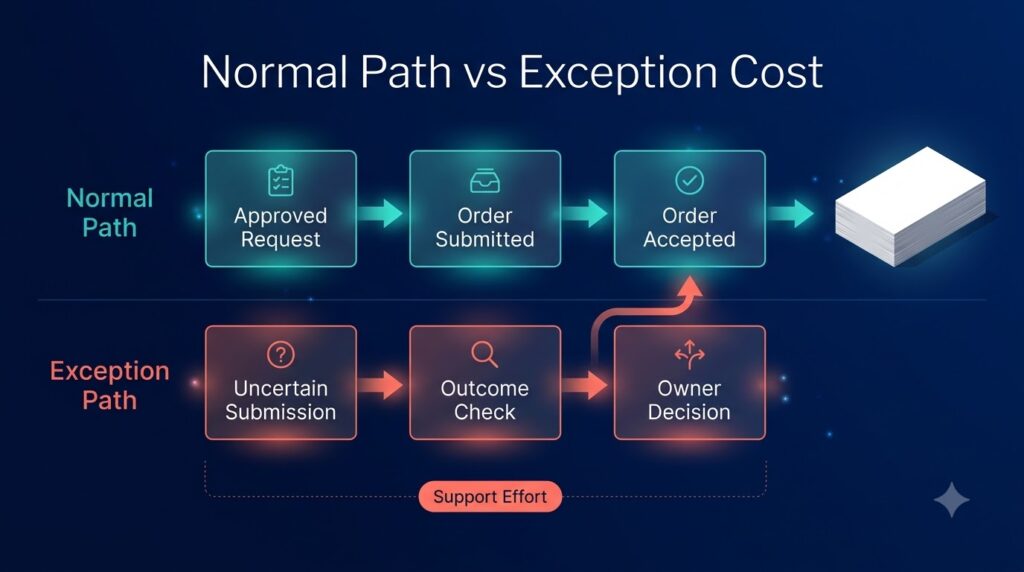
Include the cost of failures and uncertain outcomes
A normal demonstration shows an approved request reaching BCM. Cost evaluation also needs the cases that require investigation. Ask who handles an incomplete payload, rejected allocation, expired credential, or transfer that does not receive a clear response. Determine which support activities are included and what evidence the enterprise must supply.
An uncertain submission is particularly useful to discuss. The connection may lose its response after BCM has accepted the order. Someone must establish the outcome before another purchase is attempted. Ask the implementation team to demonstrate the supported recovery procedure and estimate the effort to operate it. Confirm available BCM lookup or duplicate-handling behavior rather than assuming it.
A support allowance should reflect ownership as well as anticipated frequency. A low exception count can still cause substantial interruption if nobody has authority to resolve the cases. Compare time to reach a final decision, the number of teams involved, and any recurring manual checks. These observations can be gathered in a pilot without inventing failure rates.
Use an observed baseline for the manual alternative
Measure the existing process over a representative period. Record employee preparation time and administrator handling separately. Include requests returned for correction, approvals chased, prior orders checked, and status inquiries answered. Do not time only the final order entry screen and describe that as the entire administrative cost.
Separate active handling from elapsed waiting. A request may wait two days for approval while consuming only a few minutes of staff effort. Reducing that delay can improve readiness, but it should not be reported as two days of labor saved. Use both measures where they matter and explain the operational consequence of each.
Count requests that end without an order. An employee may already have enough current cards or may no longer need the requested change. Reviewing and closing that request is legitimate work. An integration can be evaluated for its effect on this handling without treating a purchase as the only successful outcome.
Compare first year and recurring cost on consistent assumptions
Present the initial deployment separately from the expected annual operating model. First-year cost can include implementation and rollout work that does not recur in the same form. Later years may include support, licensing, administration, and periodic changes. Use the same planning horizon when comparing proposals and state the assumptions rather than hiding them in a total.
A useful structure is implementation plus recurring service and infrastructure plus retained handling plus purchasing and fulfillment. Avoid counting the same bundled charge twice. If a quote combines software and service, ask for enough explanation to understand the scope; the provider need not use a particular invoice structure for the comparison to be valid.
Compare the alternatives using the same quantities, specifications, destinations, and service expectations. Keep the effect of print choices separate from integration savings. A lower annual total caused by ordering fewer premium cards does not prove that an API connection reduced administrative effort. Procurement should be able to identify the reason for every material difference.
Test the assumptions that could change the decision
Build a small range of scenarios using customer evidence. Compare the expected case with lower request volume and a higher-support case. The purpose is to establish whether the buying decision depends on one optimistic assumption, not to create an impressive return-on-investment percentage.
For example, an integration may be attractive only if it removes most of the current administrator handling. If approvals and exceptions still require the same people, the residual workload may be substantial. Ask the demonstration team to identify the actions that disappear, those that become shorter, and those that remain. Validate those judgments during the pilot.
Treat released staff time carefully. It may support additional regions, reduce interruptions, or allow coordinators to focus on other work. These benefits can be valuable without reducing payroll expenditure. State the expected use of the time and avoid presenting capacity improvements as guaranteed cash savings.
Agree how expansion and change will be quoted
A first deployment may cover one source environment, employee population, and approval path. Ask how adding another region, legal entity, or HR platform affects implementation and recurring charges. Reuse may reduce effort, but local mappings, permissions, and operating rules still need confirmation.
Describe a few foreseeable changes before selecting the proposal. A new office, revised card template, changed approval threshold, or replacement source field can have different owners. Ask which changes fall within routine administration and which require development or a revised statement of work. This gives the customer a practical basis for budgeting ongoing maintenance.
BCM’s enterprise integration roadmap treats source responsibility and supported integration scope as matters to establish before expansion. Use it to frame a phased investment. Connect the workflow with the clearest recurring burden first, then assess additional connections using the actual operating results.
Plan a phased BCM enterprise integration roadmap
Link implementation acceptance to demonstrable behavior
Agree on the evidence that shows the quoted work has been delivered. The acceptance discussion should cover the approved request, accepted order, returned information, and the exception procedures included in scope. A successful transfer is useful technical evidence, but it may not demonstrate that the customer can operate the complete process.
Use representative cases during acceptance. Show a normal request, a correction after approval, a duplicate attempt, and a failed or uncertain submission. Verify that the operational owner can explain the outcome. If a requested behavior is unavailable, resolve its commercial and process implications before treating the deployment as complete.
Confirm the support handoff as part of the same review. The people responsible after launch need the relevant configuration information, access responsibilities, and recovery instructions. Clarify how an unresolved implementation issue differs from a later enhancement request so that both parties can route work without repeated commercial disputes.
Prepare a comparable quote request
Provide BCM with the current request process, representative order volume, covered applications, and employee population. Include an ordinary request and one costly exception. Identify known approval rules and the required purchasing and delivery context. Mark uncertain requirements so they can be assessed explicitly rather than treated as settled facts.
Request a written scope that states the supported operations, implementation responsibilities, ongoing service, exclusions, and customer dependencies. Ask for the assumptions behind recurring costs and the treatment of expansion. The resulting proposal should make it possible to compare the complete process with the existing model and with other approaches on the same basis.
Review BCM enterprise integration options
Questions about business card ordering API pricing
Is there one standard price for a BCM API integration?
This article does not establish a standard price. Request a current scoped proposal from BCM. The actual workflow, customer environment, supported interface, implementation work, and commercial arrangement need confirmation before a figure can be used for budgeting.
Should API calls be the main basis for comparing cost?
Only if that is relevant to the actual charging model and operating requirements. Compare the complete quoted service and the customer work that remains. A connection with inexpensive calls may still require substantial administration or custom workflow maintenance.
Should printing and shipping be included in total cost?
Include them when comparing the overall business card service. Also show them separately where possible so that changes in card specifications, quantities, or destinations are not mistaken for integration savings. Avoid double-counting bundled services.
How can a pilot support a credible business case?
Measure handling and exceptions against an observed baseline using comparable requests. Establish which manual actions are removed and what new support work is introduced. Use the results to revise the cost assumptions before expanding the deployment.
Can a portal and an API workflow be quoted together?
They can be considered as parts of a proposed deployment, subject to supported BCM configuration. Ask for a comparison using the same population and approval rules. The useful distinction is the operating work included, not the presence of a particular interface label.
Request a scoped BCM integration proposal
Bring your request volumes, source applications, approval requirements, and current handling baseline to a BCM consultation. Ask for a proposal that identifies the delivered workflow and its ongoing responsibilities alongside the commercial charges. This gives procurement a clear basis for evaluating business card ordering API pricing and planning a deployment the enterprise can operate.
Request pricing or schedule a demo with Business Card Manager to review your business card ordering API integration scope.