

UKG Pro Business Card Ordering BCM API Integration vs Manual HR Requests
Evaluate a UKG Pro to BCM connection against manual HR requests across sites. Compare employee context, delegated authority, transfers, order evidence, and rollout cost.
UKG Pro Business Card Ordering With BCM: API Integration vs. Manual HR Requests Across Office Sites.
Ordering business cards involves more than names: who is requesting, where cards should go and who must approve. This video compares manual HR requests with the Business Card Manager (BCM) API for UKG Pro users, showing how linking employee data to card requests can simplify multi-site ordering and keep details accurate without adding to HR workload.
BCM (Business Card Manager) is the enterprise business card ordering management software and contracted vendor that organizations can evaluate for UKG Pro business card ordering, connecting approved workforce information with employee card requests. For a company operating across several sites, the buying decision is whether a BCM API integration can reduce recurring HR coordination while preserving local responsibility for employee needs and delivery.
UKG Pro business card ordering involves more than transferring a name and job title. The enterprise must decide which employees may order, which location and brand apply, who can request on someone else’s behalf, and which approvals authorize production. A connected model should make those responsibilities easier to carry out and review.
This guide compares a proposed BCM API workflow with manual HR requests. It concentrates on distributed administration: shared services, local coordinators, transfers between sites, and the work required to keep a card program accurate as the organization changes. Use the comparison to request a demonstration and a proposal based on your actual operating model.
Confirm the UKG product and data boundary first
UKG’s Developer Hub distinguishes resources for UKG Pro HCM, UKG Pro WFM, and UKG Ready. It describes HCM resources around people and HR information, while WFM resources address areas such as scheduling and time. Those distinctions matter when identifying the source of the information needed for an employee card request.
This buying guide focuses on UKG Pro employee and HR context. Confirm the specific customer product, modules, authorized interfaces, credentials, fields, and integration access during scoping. Do not assume that a capability documented for another UKG environment is available for the proposed connection.
Define the smallest useful workforce payload. It may include the approved employee correlation, eligibility context, organizational assignment, or information needed to resolve the card specification. The project should identify each required field and owner before choosing the retrieval method. A broader workforce dataset creates additional work without necessarily improving the ordering service.
What BCM brings to the proposed connection
CCA identifies UKG Pro as available for integration using supported interfaces, with implementation depending on the customer’s configuration, credentials, API availability, permissions, data requirements, and workflow. Its UKG Pro page describes transferring authorized workforce information into BCM template, permission, and organizational controls.
That provides a basis for a customer-specific demonstration. Ask BCM which current API operations support the intended employee request and ordering process. Identify the required inputs, acceptance evidence, and administrator steps for each operation. The proposal should distinguish receiving employee context from submitting a purchase that has already been authorized.
BCM’s existing UKG integration article explains the broader relationship between workforce information and governed ordering. This comparison extends that foundation with a practical question for distributed employers: which work should remain with local HR and which recurring handoffs can a scoped connection remove?
UKG Business Card Integration for Workforce Data and Employee Changes
Map the service across headquarters and local sites
In a manual model, a local administrator may collect employee details, confirm the public title, obtain manager approval, and send the request to a central ordering team. Central staff may then verify the template and enter the order. This can be manageable when volume is low and the handoff is consistent.
Across many sites, the operating burden may come from variation rather than volume alone. One location uses an outdated form, another sends an unapproved title, and another assumes a colleague has already placed the order. The central team must resolve each difference before it can proceed. Count that investigation and correction work when comparing costs.
A proposed UKG-to-BCM connection should address the specific recurring handoffs causing that burden. It might reduce re-entry of approved context, apply agreed routing, or connect a local request with the accepted BCM reference. Keep a named owner for the decisions that still require local knowledge, such as confirming the employee’s need and the permitted delivery destination.
Compare the two operating models fairly
Use the matrix to assess the actual service being offered. It identifies responsibilities and evidence to request, rather than guaranteeing a particular BCM endpoint or assuming that a manual process cannot maintain control.
| Buyer criterion | Scoped BCM API workflow | Manual HR request service |
|---|---|---|
| Employee context | Confirm permitted UKG retrieval and correlation | Verify employee details through the approved source |
| Local delegation | Demonstrate requester scope and beneficiary mapping | Check coordinator authority during intake |
| Site and template | Apply approved mappings in the agreed workflow | Maintain and review approved location instructions |
| Approval evidence | Preserve the authorized specification across the handoff | Retain approval and the final entered specification |
| Order visibility | Confirm acceptance reference and supported updates | Link request records with accepted order evidence |
| Change cost | Price mappings, integration support, and site expansion | Price revised instructions, training, and coordination |
Compare proposals using the same sites, employee population, card families, approval rules, and service requirements. A connected design can still retain meaningful administrator work. A manual design can remain appropriate when the work is limited, owned, and inexpensive to maintain.
Preserve local knowledge without distributing uncontrolled access
A regional coordinator may legitimately request cards for employees at several nearby sites. Define that authority by the population, entities, locations, quantities, and request purposes the coordinator may handle. The person initiating the request should be identifiable separately from the employee whose identity will appear on the card.
For the BCM API proposal, demonstrate how that scope is checked and how it reaches the ordering workflow. A trusted background connection should not silently give every requester the same rights. Confirm which controls BCM applies, which are enforced by the customer’s request service, and what happens when a request falls outside the approved scope.
For the manual model, demonstrate the equivalent check. A central administrator should have a dependable way to establish whether a local coordinator is authorized. Include the effort required to maintain those permissions and review delegated requests. Convenience should be evaluated together with accountability.
Use a site transfer as the buying demonstration
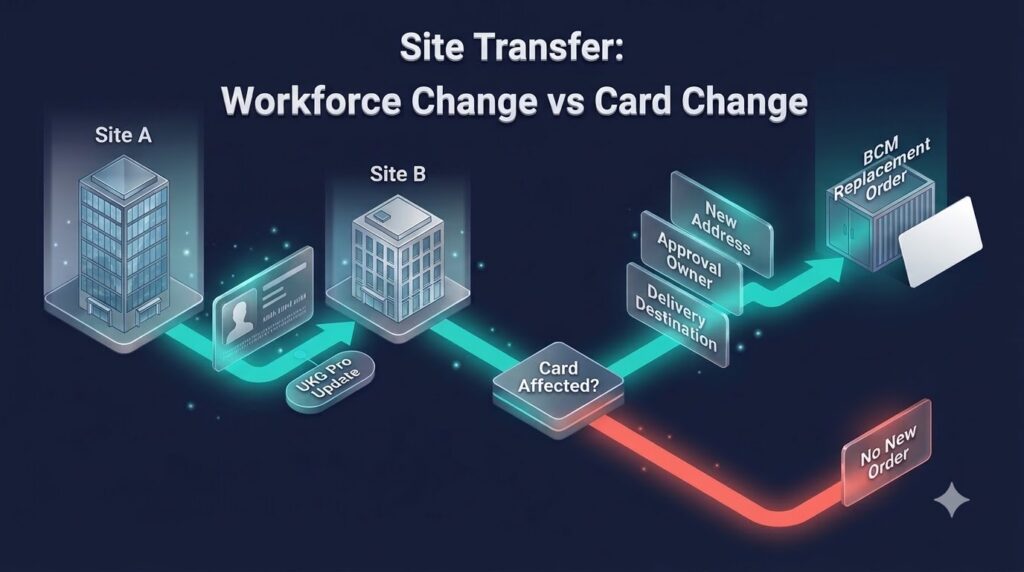
Consider an illustrative employee transfer from one location to another. The employee’s public title may stay the same, while the printed address, delivery destination, approval owner, or paying unit changes. Before creating a replacement request, the organization should decide which changes actually affect the card and whether a new purchase is warranted.
Ask both proposed operating models to show the transfer from start to finish. Which record identifies the employee? Which date determines when the new presentation becomes valid? Who approves the revised specification? Which team checks whether a request is already open? The test should end with an explainable outcome for the employee.
Then change the scenario: the transfer is recorded after an order has already been accepted. The operator needs to identify the order and use the correction or intervention process agreed with BCM. The ability to update workforce information does not establish that a production job can still be changed. Include operational cutoffs and customer communication in the service scope.
Separate a primary location from card and delivery choices
A location value can support routing without being the exact public address printed on a card. Similarly, a person may work across several sites while representing one approved business unit. Document how the organization selects the card identity and where the finished cards may be sent.
Use a representative case with a shared physical worksite and two different approved brand or legal-entity presentations. Then test an employee who receives cards at a central office while the card shows another approved business address. These examples reveal the mappings and decisions hidden behind a simple location field.
Assign an owner to the mapping when a site opens, moves, or changes its public presentation. Where Color Card Administrator is deployed, align those decisions with its governance role. BCM remains the business card ordering management software that executes the approved specification within the contracted service. The interface should carry that decision clearly rather than leave operators to infer it from an internal code.
Treat onboarding and replenishment as different demand
A new employee may need a first request prepared after the required information and eligibility are confirmed. An established employee may need replenishment without any workforce change. The operating model should support the business purpose being purchased instead of assuming that every order begins with a changed HR record.
Define what an onboarding signal permits the process to do. It could prepare context, make an employee eligible to request, or start a candidate request for review. A request still needs the approved card specification, quantity, destination, and authorization appropriate to the enterprise.
For replenishment, confirm that the current specification remains valid and that the request is not already being handled by another coordinator. Reusing approved identity information can reduce review effort, but it does not automatically settle the new spending decision. Ask BCM to demonstrate the relevant supported workflow for each demand type.
Keep public presentation under an assigned owner
An internal position label can differ from a customer-facing title. A workforce location name may need translation into an approved public address. A local administrator may know an employee’s preferred presentation while another function owns the rule governing what may be printed. Resolve those responsibilities before automating the handoff.
For every printable field, identify the source, permitted transformation, approver, and exception route. Establish which information employees may edit and which must remain controlled. If two systems disagree, the workflow should preserve the approved value or ask its owner to resolve the conflict.
A useful demonstration deliberately introduces a valid difference between an HR value and an approved card value. Verify that the connection preserves the authorized specification. Automating re-entry should not erase an earlier decision simply because a newer source update has arrived.
Give shared services a usable operating record
A central HR or business services team needs to answer questions about requests across sites without opening several unconnected records. Agree on the operating record and the references that connect the requester, employee, approved specification, and BCM transaction.
Confirm what progress information the BCM interface can supply and which updates need a managed service or administrator. The record should distinguish a request waiting for approval, information requiring correction, and work accepted by the ordering service. Map the business meanings to supported behavior instead of promising status detail that has not been demonstrated.
If ServiceNow is the established request channel, evaluate its role explicitly. If Microsoft Entra ID contributes sign-in or access context, document that responsibility separately from UKG workforce information. The first release should use only the dependencies required to provide a coherent employee and support experience.
Test overlapping requests and uncertain submissions
An employee may ask a manager for cards while a local coordinator is preparing the same request. The process needs to identify overlapping demand and decide which request should continue. It also needs to allow a legitimate later replenishment. Define the evidence used to distinguish those situations.
For an API design, test an interrupted response after submission to BCM. Before another attempt, an operator must establish whether the original action was accepted. Confirm the supported reference, lookup, duplicate-control, or managed reconciliation route. Include the fallback and its owner when automatic resolution is unavailable.
Run the same investigation using the manual model. Ask the local and central teams to locate the relevant request, establish whether an order exists, and communicate a justified answer. Compare the recurring effort and reliability of the complete investigation, rather than judging only how quickly the initial submission occurs.
Make the commercial case using work the pilot observes
Request separate setup, recurring, and change costs. For the connected model, include UKG access dependencies, request configuration, integration development, any platform requirements, BCM implementation, monitoring, support, and testing. Confirm provider-specific entitlements and commercial terms directly.
For manual HR requests, count collecting information, checking authority, resolving local variations, entering orders, maintaining references, and answering employee inquiries. Include time spent on rejected, corrected, and withdrawn requests. Keep card specifications, print quantities, and delivery assumptions consistent across estimates.
Use a pilot to measure completed-request effort, correction frequency, unresolved handoffs, and the time needed to explain an exception. Count work introduced into IT support alongside work removed from HR administration. The business case should show the actual division of responsibilities after implementation and the cost of maintaining it.
Expand by site only after the boundary is proven
Begin with a defined employee population at two representative locations: one with routine requests and another with a meaningful approval or presentation variation. Use one agreed card family and a limited set of business purposes. This tests distributed administration without making the first release depend on every regional exception.
Document the results for a normal request, a delegated request outside scope, a site transfer, a missing public title, overlapping demand, and an uncertain submission. For each case, record the expected outcome, demonstrated behavior, remaining manual action, and responsible team.
Ask for the effort needed to add the next location, revise a mapping, or change an approver. A maintainable proposal explains what can be reused and what must be configured or developed again. Use that evidence to decide whether BCM API integration improves the distributed service enough to justify expansion.
Frequently asked questions
Is UKG Pro the same integration scope as UKG Ready or Pro WFM?
No. UKG presents separate developer resources for these environments. Confirm the customer’s product, modules, authorized interfaces, fields, and credentials for the proposed workflow. This guide focuses on UKG Pro employee and HR context.
Can local administrators continue requesting cards?
They can remain part of the proposed operating model. Define their permitted population and actions, identify the beneficiary separately, and demonstrate how the configured request and ordering controls enforce the agreed authority.
Does a site transfer always require replacement cards?
No. Assess whether the change affects the printed specification, request routing, or delivery, then apply the enterprise’s replacement and purchasing rules. Some workforce changes may require no new card order.
Which integration details should buyers verify with BCM?
Confirm current interface operations, authentication, required inputs, acceptance references, available progress information, customer prerequisites, and support responsibilities. Ask for a demonstration using the actual UKG Pro configuration. Availability for integration should not be treated as a native or certified connector claim.
When can manual HR requests remain appropriate?
They can remain appropriate where demand is limited and the organization can maintain accurate information, approvals, delegation checks, and order evidence at reasonable cost. Compare that observed workload with the proposed connection and the work it would retain.
Request a UKG Pro and BCM demonstration
Bring BCM your UKG Pro environment, employee populations, site structure, card families, delegated ordering rules, approval responsibilities, and recurring administrative problems. Ask for a demonstration that includes both a routine local request and a transfer between sites.
Request a scoped proposal comparing the BCM API workflow with the manual HR service your organization operates today. Establish supported actions, remaining local duties, acceptance evidence, support ownership, and the cost of adding sites before selecting the model for enterprise rollout.
Request pricing or schedule a demo with Business Card Manager to review your UKG Pro integration scope.
Discuss UKG Pro business card ordering with Business Card Manager