

Microsoft Entra ID Business Card Integration for User Access and Employee Data
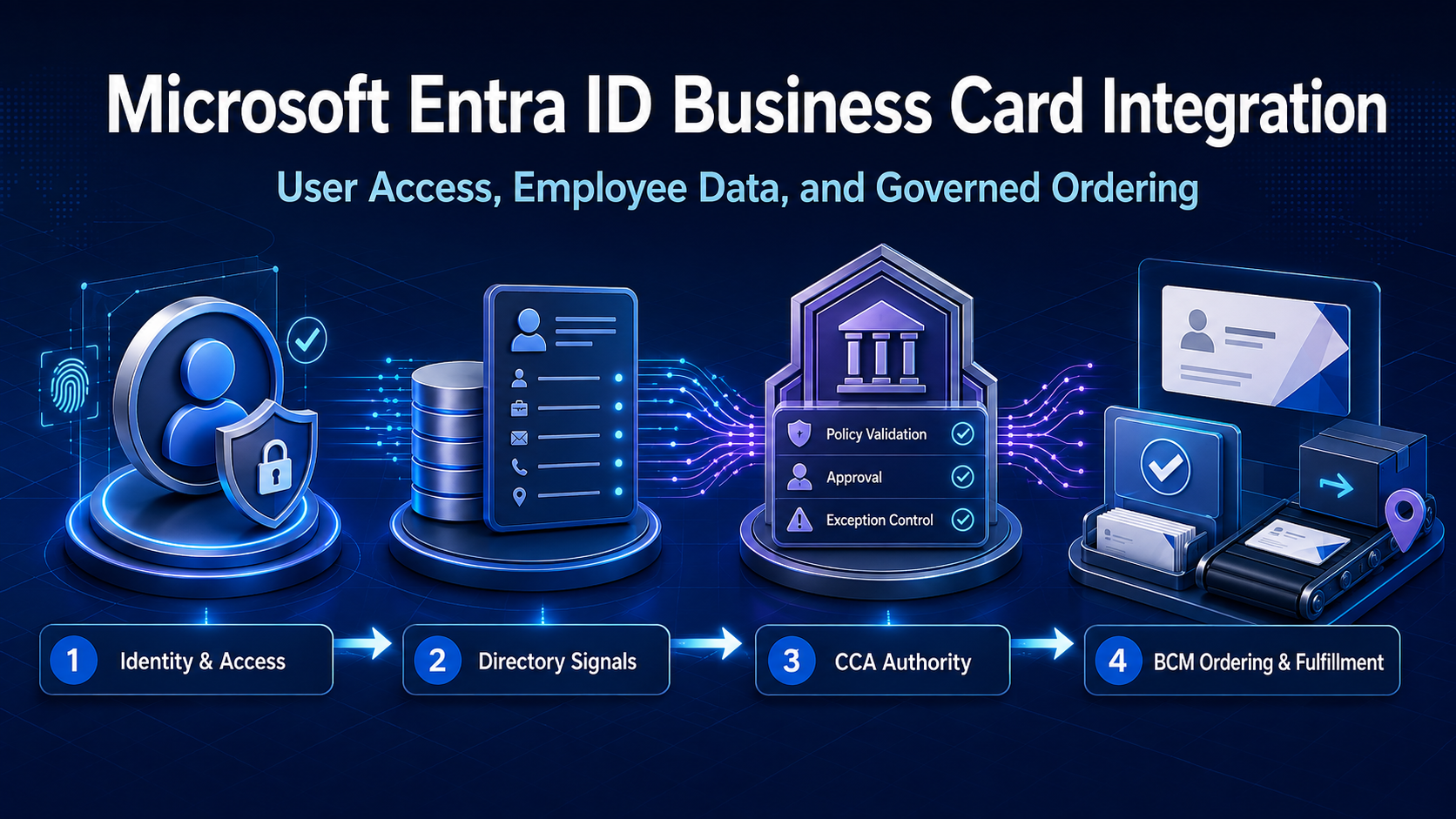
| EXECUTIVE PERSPECTIVE A Microsoft Entra ID business card integration can strengthen sign-in, user correlation, role-aware access, and lifecycle response. But authentication is not authorization to publish an identity or place an order. Entra ID supplies trusted context; CCA governs authority and exceptions; BCM executes the approved transaction. |
Directory Connectivity Should Strengthen Control, Not Replace It
Microsoft Entra ID sits close to the center of enterprise access. It can authenticate users, identify the tenant they belong to, provide approved directory attributes, expose group or role context, and reflect lifecycle changes such as account creation, transfer, disablement, or departure. Connecting those signals to business card ordering can reduce shared credentials, duplicate entry, stale access, and manual administration.
The integration boundary matters. A successful sign-in proves that an identity met the configured authentication requirements. It does not prove that the person may order a business card, use a particular template, print every directory field, represent a legal entity, select an unrestricted quantity, or act for another employee. Those are business-governance decisions.
Business Card Manager (BCM) manages the controlled request, approval, template, order, supplier, and fulfillment process. Color Card Administrator (CCA), where deployed as the enterprise authority layer, can interpret directory and workforce context, govern eligibility and public presentation, constrain delegated actions, resolve source conflicts, and release an approved identity specification to BCM.
Why Microsoft Entra ID Is a High-Value BCM Integration
Microsoft Entra ID is the third priority in the approved BCM integration roadmap because identity and access controls affect every distributed ordering program. Its value is not simply single sign-on. It is the ability to connect an authenticated user and governed directory context to the correct account, population, role, template family, approval path, and lifecycle policy.
- Use enterprise authentication instead of unmanaged shared ordering credentials.
- Correlate users through stable identifiers rather than relying only on mutable email addresses.
- Apply tenant, group, role, location, or organizational context to configured access decisions.
- Prepopulate permitted employee attributes while minimizing unnecessary directory data.
- Respond to joiner, mover, and leaver events by granting, changing, or removing request authority.
- Improve evidence across authentication, policy, approval, order, fulfillment, and exception outcomes.
Entra ID should remain authoritative for the digital-identity facts it legitimately owns. It should not automatically decide externally presented titles, public addresses, legal lines, card eligibility, quantities, or production release. Those values may depend on HR, brand, legal, procurement, local administration, or other authoritative sources.
What a Governed Entra ID-to-BCM Workflow Looks Like
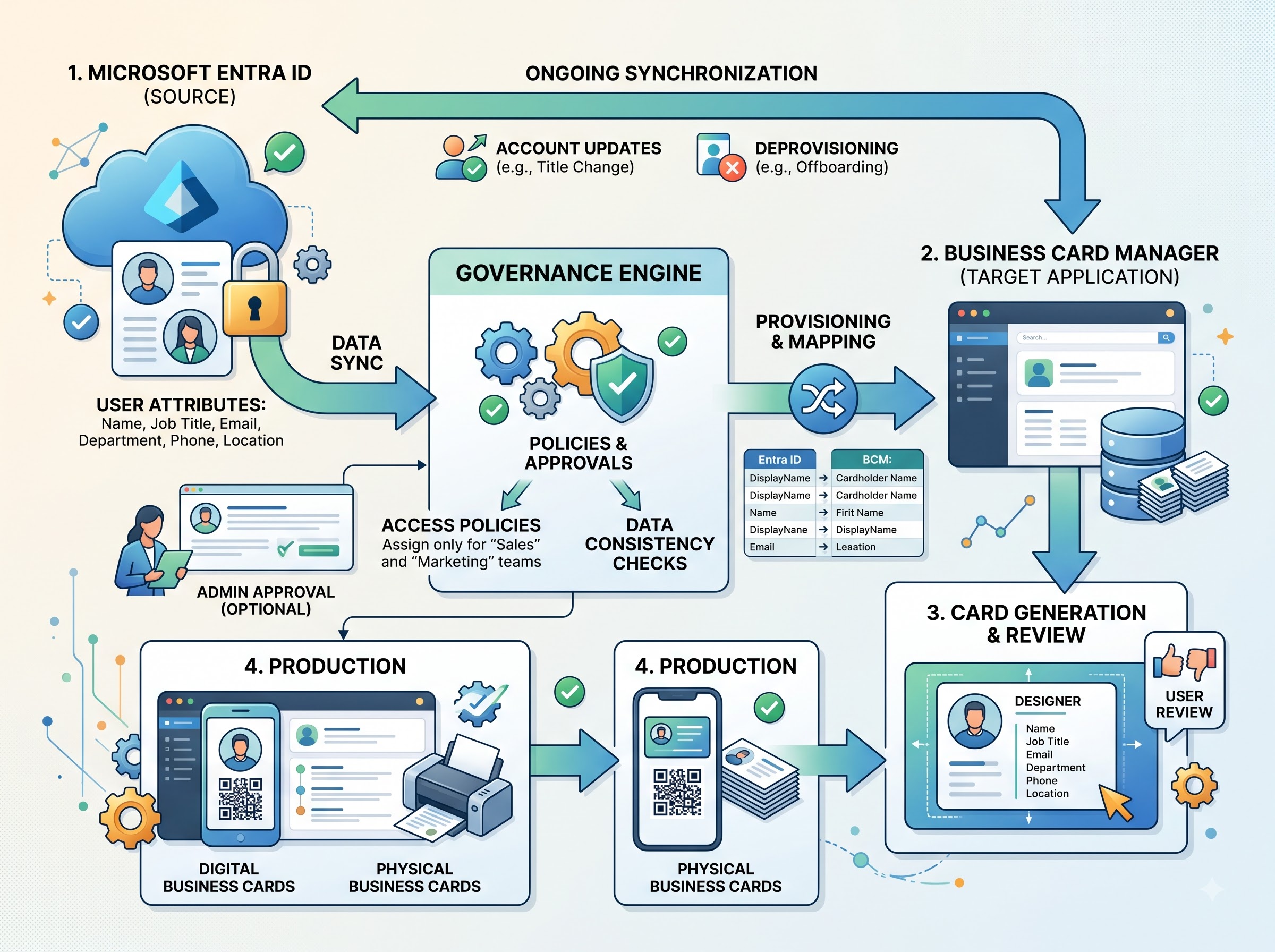
A strong integration uses authentication and directory context as inputs to a governed decision. Exact protocols, APIs, claims, groups, roles, provisioning mechanisms, field mappings, and timing should be configured for the organization’s Entra tenant, security architecture, CCA policies, and BCM environment.
- Authenticate the user. Entra ID validates the sign-in under the organization’s configured controls. Tenant and stable user identifiers are captured for correlation.
- Retrieve minimum approved context. Only required claims or directory attributes are used, such as approved organizational, location, role, or status context.
- Determine request authority. CCA or configured policy evaluates eligibility, self-service rights, delegated scope, template access, population boundaries, and lifecycle state.
- Govern printed identity. Approved sources and mappings determine names, public titles, contact details, legal entities, brands, languages, and exceptions.
- Execute through BCM. BCM applies validation, approvals, template controls, quantity rules, ordering, supplier routing, shipping, and fulfillment visibility.
- Preserve linked evidence. Authorized teams can reconstruct the user context, policy decision, request version, approval, order, production status, and exception outcome.
The Identity and Access Decisions That Matter
Integration quality depends on defining what each signal means before it is allowed to influence ordering. Enterprise teams should separate authentication, eligibility, authorization, data authority, and production release.
| Control area | Enterprise question | Governed response |
|---|---|---|
| Authentication | Who successfully signed in? | Validate tenant, user, assurance context, and stable correlation identifiers. |
| Eligibility | May this person request a card? | Apply worker, role, location, status, sponsorship, and population rules. |
| Authorization | What may the user do? | Constrain self-service, request-on-behalf, administration, approval, and template access. |
| Field authority | Which source owns each printed value? | Use approved precedence, mappings, transformations, and conflict handling. |
| Lifecycle | What changes when access changes? | Reroute pending work, revoke authority, block release, and reconcile open orders. |
Authentication Is Not Business-Card Eligibility
Many authenticated users may not be eligible to represent the enterprise through a printed identity asset. Guests, contingent workers, service accounts, acquired populations, interns, external partners, and users in restricted jurisdictions can all exist in the directory without having the same business-card rights as active employees.
A governed model evaluates the user’s population, status, sponsorship, location, role, and applicable policy before exposing an ordering path. Conditional Access and multifactor authentication can improve confidence in the sign-in, but they do not replace business card approval, brand policy, legal review, or purchasing authority.
Directory Attributes Are Inputs, Not Automatically Printable Truth
Directory profiles often contain useful values such as display name, job title, department, office, phone number, and manager. They may also be optimized for internal collaboration rather than external representation. A directory title can be abbreviated, outdated, inherited from an upstream system, or inconsistent with an approved customer-facing title. An office value may identify a building but not the public mailing address.
Field-level governance should document the authoritative source, allowed transformations, permitted populations, public-presentation rule, effective date, and exception owner for every printed value. Data minimization is equally important: the integration should retrieve only what the declared ordering and governance purpose requires.
Joiners, Movers, and Leavers Require Lifecycle-Aware Execution
Joiner events can establish access and create a candidate request, but readiness may depend on employment status, effective date, required fields, sponsorship, template eligibility, and production lead time. A new account should not automatically become an order.
Mover events can change groups, roles, locations, legal entities, brands, approval relationships, or delegated scope. The workflow should distinguish access-only changes from material printed-identity changes. Leaver or disablement events should remove request authority, close or reroute pending decisions, block unreleased specifications, and attempt to cancel or reconcile open BCM orders where operationally possible.
Operational Benefits Across IT, HR, Marketing, and Procurement
For IT and security, the integration supports enterprise authentication, scoped application access, service-identity governance, centralized offboarding, and better traceability. It also reduces reliance on shared logins and locally administered user lists.
For HR and business administrators, directory context can reduce re-entry and help route users to the correct population, manager, location, or account. Marketing and brand teams, centrally governed templates and field policies prevent convenient directory synchronization from becoming uncontrolled public identity.
For procurement and finance, role-aware ordering improves accountability for quantities, cost allocation, duplicate requests, reorders, suppliers, and exceptions. Audit and risk teams, linked evidence makes it possible to explain who acted, under which identity and policy context, what was approved, and what BCM ultimately produced.
Controls That Should Remain Inside CCA and BCM
Identity connectivity should strengthen—not bypass—the controls that protect enterprise identity, brand, spend, and fulfillment. The operating model should retain controls such as:
- CCA eligibility, policy, delegated-scope, source-authority, lifecycle, and exception decisions;
- BCM role-based access to accounts, templates, locations, and ordering actions;
- required-field validation, permitted-value controls, and material-change reapproval;
- locked templates and approved regional, language, brand, or legal-entity variations;
- quantity limits, reorder rules, duplicate checks, cancellation handling, and supplier routing;
- linked authentication, request, approval, order, fulfillment, and audit evidence.
This separation keeps responsibilities clear. Entra ID establishes and describes the digital identity; CCA determines business identity authority; BCM converts the approved specification into a controlled order and returns execution evidence.
Implementation Priorities for Enterprise Teams
Begin with one tenant, one controlled employee population, self-service requests, and a small set of required claims or attributes. Document identity correlation, authoritative sources, eligible populations, group and role semantics, public-presentation rules, delegated actions, template families, approvers, suppliers, privacy constraints, and failure behavior before enabling broader automation.
Technical design should use least-privilege scopes, approved application or managed identities, protected credentials or certificates, verified tenant and environment boundaries, data minimization, logging, monitoring, retry controls, idempotency, correlation identifiers, retention rules, and owned failure queues. Avoid depending on display names or email addresses when a stable identifier is available.
Testing must cover guests, contractors, disabled accounts, duplicate users, renamed users, multiple tenants, stale groups, delayed lifecycle events, privilege changes, missing claims, directory outages, expired credentials, throttling, retries, out-of-order events, post-approval changes, supplier failures, and termination while an order is open. Useful measures include unauthorized-request prevention, correction rate, access-removal time, approval cycle time, exception volume, duplicate orders, avoidable reprints, cancellation success, and fulfillment visibility.
From Enterprise Sign-In to Governed Identity Execution
Microsoft Entra ID can give BCM-connected enterprises a stronger foundation for authentication, user correlation, directory context, and lifecycle response. CCA turns those signals into governed eligibility, authority, presentation, access, and exception decisions. BCM converts the approved outcome into ordering and fulfillment.
The strategic advantage is not directory-driven printing. It is identity-connected enterprise execution excellence: trusted sign-in, minimum necessary data, clear authority, controlled public presentation, appropriate approval, rapid lifecycle response, visible fulfillment, and evidence the organization can review. That is how a Microsoft Entra ID business card integration becomes enterprise infrastructure rather than another login option.
| Connect Enterprise Identity to a Governed Business Card Workflow Explore how Business Card Manager can support authenticated access, controlled employee requests, approvals, templates, ordering, fulfillment, and reporting. Request a BCM demonstration and Microsoft Entra ID integration-fit discussion at https://www.businesscardmanager.com/. |