

Business Card Ordering for Distributed Employees
Compare BCM API workflows with manual address collection for distributed employees. Evaluate destination authority, current confirmation, private information handling, corrections, and failed deliveries.
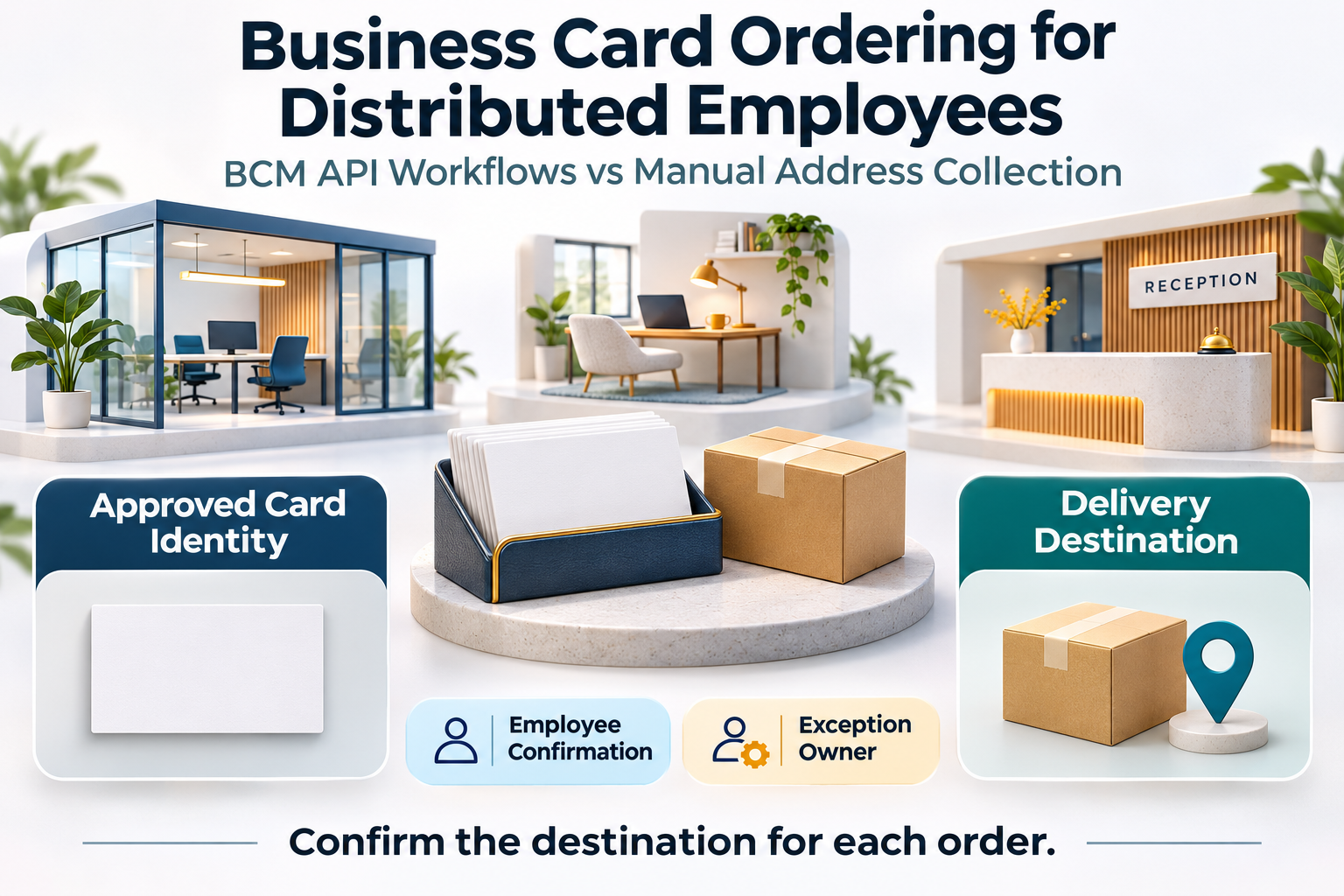
BCM (Business Card Manager) is the enterprise business card ordering management system and contracted business card vendor that converts authorized specifications into controlled orders. Business card ordering for distributed employees requires a reliable connection between the approved card and the place where the employee can receive it. Employees working across offices, remote locations, and temporary assignments may share a brand while needing different delivery arrangements.
For enterprise buyers, the decision is whether a scoped BCM API workflow can reduce repeated address handling and improve the visibility of unresolved work compared with manual collection. The value depends on accurate information, clear authorization, and a workable service process. Connecting applications does not establish that a destination is allowed, that a package can be redirected, or that every location has the same delivery service.
This article compares the two approaches from destination selection through delivery exceptions. It focuses on the distinction between printed identity and shipping information, current destination confirmation, changes after submission, and support ownership. The proposed controls are buying requirements; actual BCM interface operations, geographic coverage, delivery options, and intervention arrangements require confirmation for the contracted deployment.
Separate the Address on the Card from the Delivery Destination
The office address approved for publication may differ from the destination used to deliver the cards. A remote employee may use a corporate office address on the card while receiving the package through another authorized arrangement. A regional team may collect cards at a central reception point without changing the public identity printed for each employee.
Define these fields separately in the ordering model. Establish which authority controls the published address and which process authorizes the delivery destination. A change to shipping information should not rewrite artwork, and a template update should not automatically redirect an open order.
Where Color Card Administrator is deployed, CCA governs the approved public identity and related exceptions. BCM executes the authorized business card purchase. BCM’s published operating model places ordering within a wider set of identity, approval, production, and delivery controls. Apply that distinction when reviewing forms and integrations so that one generic address field does not serve several incompatible purposes.
Review BCM business card ordering governance
Compare the Full Address Collection Process
Manual collection may use an approved form, employee confirmation, and administrator review before the destination is entered into the order. This can be practical for occasional requests. Its recurring effort includes chasing missing details, checking whether an older address is still suitable, and matching corrections to the right order.
A connected workflow may retrieve approved location information or collect a destination through a customer application and pass it to BCM through supported operations. The integration still needs policy decisions and exception handling. A complete field does not establish that the employee will be present or that the receiving location is permitted for the purchase.
| Buying criterion | Scoped BCM API workflow | Manual address collection |
|---|---|---|
| Destination source | Use agreed sources and confirmation | Collect and verify current details |
| Printed identity | Keep shipping fields separate | Check artwork against approved identity |
| Authorization | Apply permitted destination rules | Verify destination and exceptions |
| Corrections | Track requested and confirmed change | Match correspondence to the order |
| Information access | Limit fields by role and purpose | Control forms, attachments and recipients |
| Recovery | Link individual outcomes and owners | Maintain references and follow up |
Compare both options with the same employee scenarios and delivery expectations. Include a normal office delivery, a remote destination, an employee moving before arrival, and a failed delivery. Ask the operator to show the verified destination, the current order position, and the person responsible for any unresolved action.
Decide Which Destinations the Enterprise Permits
A distributed workforce does not imply unrestricted delivery to any address supplied by an employee. Define the permitted destination types for the program, such as maintained offices, approved collection points, or individually authorized locations. Identify who may grant an exception and which commercial conditions require additional review.
Establish the business reason for each arrangement. Direct delivery may reduce internal redistribution, while office collection may suit employees who visit regularly. A temporary location may be appropriate for a specific need but unsuitable as the default for later reorders. Evaluate the actual service and operating implications before choosing a universal rule.
Confirm the available destinations and delivery methods with BCM for the contracted scope. Do not infer international service, residential delivery, customs handling, or a particular carrier from API availability. The proposal should identify what is supported, what requires further assessment, and how unsupported requests reach the customer’s responsible owner.
Use the Appropriate Source for Each Delivery Fact
HR location information may identify an employee’s assigned office without establishing where the person can receive a package this week. A directory record may contain an approved business address but omit a suite, reception instruction, or collection contact. The most convenient source is not necessarily authoritative for every delivery field.
Define the source, permitted use, and correction owner for the information required. Use maintained location references for approved offices where practical, while preserving a controlled route for destinations that require employee confirmation. Keep the employee reference distinct from the location reference so that a shared office does not merge separate beneficiaries.
BCM’s HCM and CRM integration model describes governed workforce facts and limited business context as inputs to ordering. For delivery design, treat that as a starting point for field ownership, not permission to reuse every source attribute. Confirm which data the proposed connection actually needs and whether a separate destination confirmation is required.
Explore the BCM HCM and CRM integration model
Confirm the Destination for the Specific Request
An employee may have received cards successfully at a location last year and now need a different arrangement. A reorder should assess whether the earlier destination remains appropriate. Define when the employee, coordinator, or location owner must confirm the current receiving details and what makes an older confirmation unsuitable.
Make the confirmation understandable. Show the relevant destination and request context to the authorized person rather than asking them to approve an unexplained location code. If the order is needed for an event, distinguish the requested arrival date from the period during which the employee can receive it.
Test a request prepared before an employee relocation. The operator should be able to identify whether confirmation is current enough for the intended purchase. Avoid assuming an API connection will detect every real-world move; employee action and an assigned follow-up owner may still be necessary when source systems do not hold the required information.
Check Completeness Without Promising Successful Delivery
A destination can pass format checks and still be unsuitable. Missing unit information, an incorrect receiving contact, an unattended collection point, or a location that cannot accept the selected delivery method can create a service problem even when the address appears structurally complete.
Specify the validation available in the proposed deployment and the limits of what it establishes. If an external validation service is part of the design, confirm its role, access, coverage, and operating owner. Do not describe address validation as a standard BCM capability without evidence of the actual supported configuration.
Provide a correction route that preserves the request relationship. An administrator should know which detail needs attention and who can confirm it. The employee should not need to send the same private destination to several teams just because the original form did not collect enough information. Compare the manual and API options on resolution effort as well as first-pass completeness.
Keep Delivery Information Within the Necessary Audience
A private destination can be operationally necessary without belonging in the artwork, general employee profile, manager notification, or broad reporting export. Define where the information is collected, who needs it, and which systems receive it. Apply the enterprise’s applicable privacy and retention policies to the implemented workflow.
A manager may need to authorize an exceptional shipping cost without receiving the full destination in a routine email. Integration support may need a transaction reference and error description rather than a complete address. Include attachments, notifications, exports, and logs when reviewing how information moves through the process.
The manual alternative needs deliberate controls too. Avoid treating an expanding email thread as the address record. For the connected option, inspect the information available to each user role and to the technical integration account. A limited employee screen does not prove that every downstream copy has the same limits.
Handle Address Changes According to the Actual Order Stage
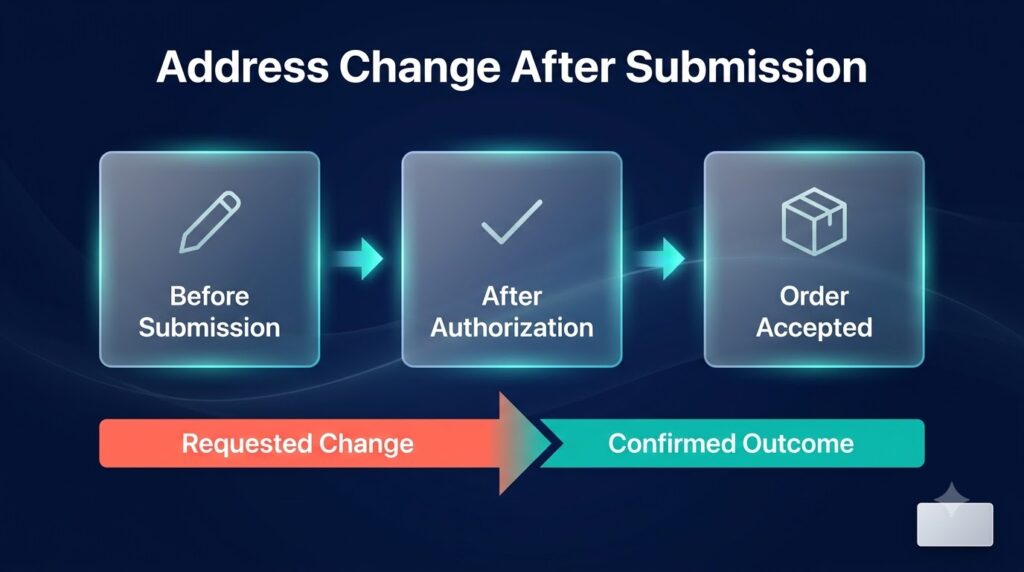
A correction before submission may be a straightforward update to an unapproved request. A change after authorization may require renewed review if it alters the delivery arrangement or cost. Once the order is accepted or fulfillment has begun, the available action depends on the contracted service and current transaction position.
Define who contacts BCM and how the verified response reaches the employee. A saved destination change in a customer application does not establish that the accepted order was amended. The service record should distinguish the requested action from the confirmed outcome.
Demonstrate a correction received after submission. The operator should locate the relevant order, follow the supported intervention route, and record what was confirmed. Do not promise automatic redirection, cancellation, shipment interception, or free replacement. If another purchase is required, retain the relationship to the original issue and obtain the appropriate authorization.
Preserve the Destination Associated with Each Order
Employee profiles change over time. Historical order evidence should still establish which destination was authorized and used for a particular transaction, subject to the enterprise’s record policies. Showing only the employee’s current address can make a past delivery difficult to investigate.
Associate the request, approved destination reference or snapshot, order, and available shipment references. The required evidence should support investigation without distributing the entire destination history across every application. Decide which system retains the authoritative record and how an authorized support person accesses it.
Test an employee with two legitimate orders sent to different places. A status inquiry should identify the correct transaction and its destination context. Matching solely by employee name or current office is insufficient when the program includes several purchases, a replacement, or a later change in work arrangement.
Give Failed Deliveries an Owner and a Recovery Decision
A delivery concern may involve an incomplete destination, employee absence, a receiving-office problem, or an order that cannot be located. These cases need investigation rather than an automatic new purchase. Establish who gathers the facts and who can authorize the next action under the contracted arrangement.
Keep the relevant references and last verified position available to the service team. If tracking information exists, state what it establishes and what still needs checking. A package reported delivered to an office may require internal distribution follow-up before the employee receives it.
For a remote employee, provide a clear route to report the issue without exposing delivery details to unnecessary recipients. Record whether the resolution involves an available service intervention, a corrected future destination, or a separately authorized replacement. Close the case when the agreed evidence supports the outcome, with any remaining financial or service obligation assigned to its owner.
Coordinate Multiple Destinations Without Losing Individual Outcomes
A team campaign can contain employees receiving cards through several locations. Group administration may simplify preparation, but the request and delivery relationships still need to be visible for each beneficiary. One shipment or campaign completion label should not conceal employees whose cards remain unresolved.
Decide how partial progress is communicated. Some orders may be accepted while others await destination confirmation. A coordinated launch may require a common release decision, while independent employee needs may permit separate processing. Establish the policy before a missing detail forces an improvised choice.
For the manual option, maintain a controlled register of submitted requests and related outcomes. For the integrated option, demonstrate record-level results and recovery after an interruption. Reconcile uncertain submissions through supported records or BCM assistance before repeating work, so that an address correction does not accidentally create a duplicate purchase.
Scope Integrations Around the Receiving Workflow
Workday, SAP SuccessFactors, Oracle HCM, ADP, UKG, or Dayforce may contribute workforce and assigned-location information. Microsoft Entra ID may supply approved directory attributes. ServiceNow may host destination confirmation and service conversations, while Dynamics 365 or HubSpot may contribute limited business context. Establish which roles apply in the customer’s actual environment.
Confirm the permitted data, available customer access, and supported BCM operations. The proposal should identify which component collects confirmation, authorizes exceptions, submits the purchase, and returns available status. A named application does not establish a native connector or a universal address update interface.
Where Business Ops Center is deployed for cross-system oversight, define its responsibility for correlation and unresolved work. Preserve CCA’s public identity authority and BCM’s ordering execution role. The operating team should know which person corrects a source record, which person resolves a delivery question, and who confirms recovery after a technical failure.
Explore BCM integration options
Pilot the Service with Representative Delivery Cases
Choose a limited population that reflects the intended destination types and support arrangements. Include an office collection, an individually confirmed destination, missing receiving details, a planned move, and a correction after submission. Use agreed testing arrangements and representative information before authorizing real purchases.
Measure administrator handling time, missing confirmations, correction effort, delivery inquiries, and unresolved cases. Compare these with the manual collection process. Separate data-handling improvements from physical delivery performance; fewer emails do not establish shorter transit times or broader service coverage.
BCM’s implementation guidance recommends establishing the operating model and measuring a baseline before rollout. Use the pilot to confirm ownership and the actual supported delivery scope. Expand when the team can explain each employee’s current order position and resolve exceptions during absence or outage without relying on private spreadsheets and personal memory.
Read the enterprise BCM implementation guide
Questions About Business Card Ordering for Distributed Employees
Should the delivery destination appear on the business card?
Only when it is also the approved public address for that card. Keep printed identity and shipping information separate, with the appropriate authority and permitted use defined for each.
Can an HR office location replace destination confirmation?
Only when the enterprise has established that it is current and suitable for the receiving arrangement. An assigned office can differ from the place an employee can receive cards for a specific request.
Does a BCM API connection guarantee delivery to every location?
No such coverage should be assumed. Confirm the supported destinations, delivery methods, service terms, and exception route for the actual deployment before making commitments to employees.
Can employees redirect an accepted order by updating their profile?
A profile update does not prove the order changed. Follow the supported intervention route for the actual order stage and communicate the verified outcome. A replacement purchase requires appropriate authorization.
How should buyers compare API workflows and manual collection?
Use the same destination scenarios and service expectations. Compare confirmation accuracy, administrator effort, information visibility, correction handling, and ownership of unresolved deliveries, including ongoing integration support.
Request a BCM Distributed Employee Ordering Assessment
Bring examples of your approved destination types, a recent address correction, and a delivery concern that required manual follow-up. Ask BCM to demonstrate the supported ordering path and identify where customer applications collect confirmation and retain evidence. Compare the proposed API workflow with manual collection using the same privacy, approval, and receiving requirements. Establish who owns exceptions so that each authorized card order reaches a verifiable service outcome.
Request pricing or schedule a demo with Business Card Manager to review your distributed employee delivery integration scope.
Discuss business card ordering for distributed employees with BCM