

Why Enterprise Business Card Management Should Be Part of Every Digital Workplace Strategy

Introduction
A digital workplace is more than a collection of collaboration tools.
It represents an operating model where employees, processes, systems, and governance operate together through connected digital experiences.
Modern enterprises increasingly rely on platforms such as:
- Human Resource Information Systems (HRIS)
- Identity and Access Management (IAM)
- Enterprise Resource Planning (ERP)
- Customer Relationship Management (CRM)
- Procurement Platforms
- Collaboration Suites
- Workflow Automation Platforms
- Enterprise Analytics
These systems collectively improve productivity while reducing operational complexity.
However, many organizations continue managing employee-facing identity assets outside this ecosystem.
Business cards frequently remain disconnected from enterprise workflows despite representing one of the most widely distributed physical expressions of corporate identity.
Digital workplace maturity requires eliminating these isolated processes.
Digital Transformation Requires Process Integration
Successful digital transformation is rarely achieved by implementing new software alone.
Instead, transformation occurs when organizations integrate fragmented business processes into governed enterprise workflows.
Disconnected activities create:
- Duplicate work
- Manual approvals
- Inconsistent information
- Limited reporting
- Increased compliance risks
- Poor employee experiences
Business card management often demonstrates all of these characteristics.
Employees complete manual request forms.
Managers approve requests through email.
Marketing reviews branding separately.
Procurement contacts suppliers independently.
Finance processes invoices manually.
Regional offices maintain different procedures.
The result is an operational process that contradicts the objectives of enterprise digital transformation.
Business Card Manager integrates these activities into a single governed workflow.
Employee Experience Begins with Operational Simplicity
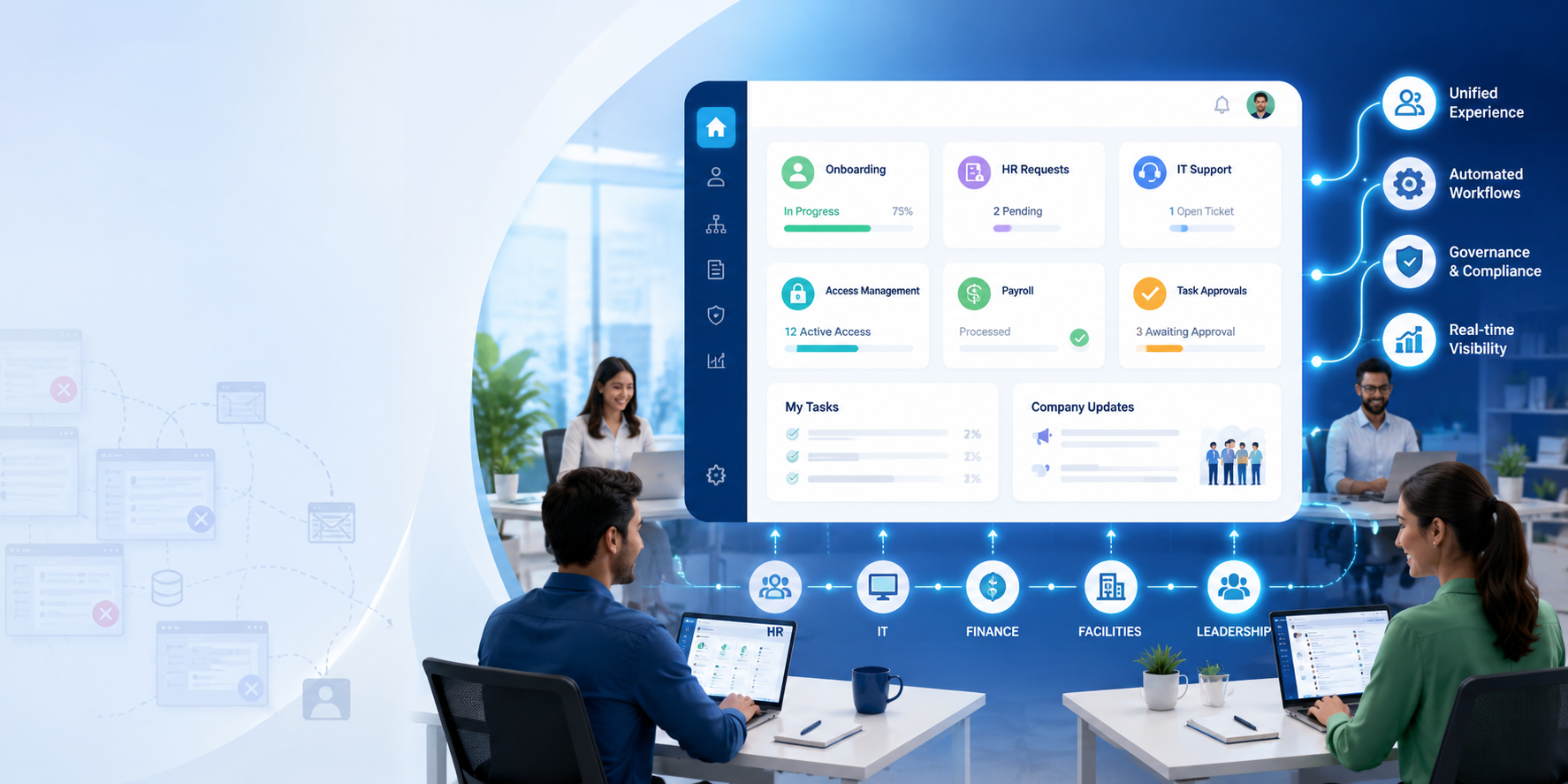
Digital workplaces focus heavily on employee experience.
Employees increasingly expect enterprise services to be intuitive, automated, and available through standardized workflows.
Business card requests should reflect these same expectations.
Without centralized management, employees often experience:
- Multiple request forms
- Confusing approval paths
- Long turnaround times
- Inconsistent communication
- Uncertainty regarding request status
- Repeated data entry
These inefficiencies reduce employee satisfaction while increasing administrative workloads.
BCM simplifies the experience by providing standardized request workflows that automatically route approvals, validate information, enforce policies, and communicate status updates throughout the fulfillment process.
Employees benefit from transparency.
Administrators benefit from automation.
Leadership benefits from governance.
Connecting Business Cards with Enterprise Identity
Business cards should not exist independently from employee identity management.
Instead, they should reflect approved enterprise identity information maintained across organizational systems.
Employee identity typically includes:
- Legal name
- Preferred name
- Position
- Department
- Division
- Business unit
- Office location
- Contact information
- Corporate branding
- Organizational hierarchy
Maintaining duplicate identity information inside disconnected business card systems increases the likelihood of errors.
BCM enables organizations to align business card information with approved enterprise identity sources, reducing inconsistencies while strengthening governance.
Brand Governance Supports Digital Consistency
Digital workplace transformation extends beyond internal systems.
It also influences how organizations present themselves externally.
Every interaction with customers reinforces—or weakens—the enterprise brand.
Business cards remain important during:
- Executive meetings
- Customer visits
- Supplier negotiations
- Government engagements
- Industry conferences
- Trade exhibitions
- Sales presentations
An inconsistent business card communicates operational inconsistency.
Examples include:
- Different logo versions
- Outdated typography
- Incorrect color usage
- Legacy addresses
- Inconsistent titles
- Unauthorized layouts
These inconsistencies may appear minor individually but collectively affect enterprise credibility.
Business Card Manager protects brand governance by ensuring every business card follows centrally approved templates and identity standards.
Workflow Automation Improves Operational Efficiency
One of the defining characteristics of a digital workplace is workflow automation.
Automation reduces repetitive administrative activities while ensuring policies remain consistently enforced.
Within business card management, automation supports:
- Employee onboarding
- Request validation
- Approval routing
- Template selection
- Procurement authorization
- Vendor assignment
- Production tracking
- Delivery notifications
- Reporting
Rather than relying on manual coordination between multiple departments, BCM orchestrates these activities through configurable enterprise workflows.
Automation improves speed without compromising governance.
Procurement as a Digital Workplace Function
Digital workplace initiatives increasingly integrate procurement into operational workflows.
Business card management provides an excellent example of this integration.
Every approved request ultimately results in procurement activity involving:
- Approved vendors
- Enterprise contracts
- Purchase policies
- Cost allocation
- Budget ownership
- Invoice reconciliation
Without centralized governance, procurement visibility becomes fragmented.
Departments negotiate independently.
Regional pricing varies.
Supplier performance becomes difficult to evaluate.
BCM integrates procurement governance directly into workflow execution, allowing organizations to maintain financial visibility while simplifying employee experiences.
Supporting Global Enterprises
Modern organizations increasingly operate across multiple countries and regions.
Digital workplace platforms must therefore support:
- Multiple languages
- Regional branding variations
- Local suppliers
- Geographic compliance
- Distributed approvals
- Global reporting
Business Card Manager accommodates these enterprise requirements through centralized governance combined with configurable regional flexibility.
Organizations maintain consistent governance while allowing approved localization where business needs require it.
Compliance and Governance in the Digital Workplace
As organizations become increasingly digital, governance becomes more—not less—important.
Automation without governance simply enables organizations to make mistakes faster.
Enterprise business card management must therefore operate within clearly defined governance policies that ensure every request complies with corporate standards.
These governance controls typically include:
- Role-based permissions
- Standardized templates
- Approval hierarchies
- Brand compliance
- Procurement policies
- Vendor authorization
- Audit logging
- Lifecycle tracking
Business Card Manager (BCM) embeds these controls into every stage of the workflow.
Rather than expecting employees to remember corporate policies, the platform enforces them automatically through configurable business rules.
This governance-first approach significantly reduces operational risk while ensuring every business card reflects approved enterprise standards.
Audit Readiness Through Complete Lifecycle Visibility
Enterprise governance depends on traceability.
Organizations should be able to answer questions such as:
- Who requested the business card?
- Which employee information was used?
- Which template version was approved?
- Who authorized the request?
- Which supplier fulfilled the order?
- When was the card delivered?
- What changes occurred during the lifecycle?
Without centralized systems, answering these questions often requires searching emails, spreadsheets, procurement records, and vendor communications.
BCM maintains a complete audit trail that captures every significant lifecycle event.
This centralized history supports:
- Internal audits
- Procurement reviews
- Brand compliance assessments
- Operational governance
- Regulatory reporting
- Continuous improvement initiatives
Audit readiness becomes an inherent outcome of the process rather than an additional administrative effort.
Enterprise Analytics Drive Better Decisions
Digital workplace platforms generate valuable operational intelligence.
Business card management should contribute to that intelligence rather than remain an isolated administrative function.
BCM enables enterprise reporting across multiple operational dimensions, including:
- Business card requests by department
- Requests by geographic region
- Employee onboarding volumes
- Replacement trends
- Approval turnaround times
- Procurement expenditure
- Supplier performance
- Policy exception frequency
- Template utilization
- Brand compliance metrics
These insights allow leadership teams to evaluate operational performance and identify opportunities for process optimization.
For example, recurring replacement requests from a particular business unit may indicate frequent organizational changes, while unusually long approval cycles could reveal workflow bottlenecks that affect employee productivity.
By converting operational activity into measurable business intelligence, BCM helps organizations continuously improve governance and service delivery.
Integrating BCM with Enterprise Platforms
Business Card Manager is designed to complement—not replace—existing enterprise platforms.
Its greatest value is realized when it becomes part of the organization’s broader digital workplace architecture.
Common integration scenarios include:
Human Resources (HRIS)
Approved employee records automatically provide authoritative information for business card creation, reducing duplicate data entry and ensuring consistency from the first day of employment.
Identity and Access Management (IAM)
Employee status changes, promotions, transfers, or offboarding events can trigger governed business card workflows, ensuring identity assets remain aligned with organizational reality.
Enterprise Resource Planning (ERP)
Cost centers, budgeting information, procurement approvals, and financial reporting can be synchronized to strengthen procurement governance.
Customer Relationship Management (CRM)
Sales and customer-facing teams maintain consistent professional identity across customer interactions, reinforcing enterprise branding.
Procurement Platforms
Approved supplier catalogs, negotiated pricing, purchasing rules, and invoice processes become integrated into a single governed workflow.
Rather than creating another isolated application, BCM strengthens the overall enterprise technology ecosystem by connecting identity, procurement, workflow, and governance.
BCM Within the Enterprise Governance Ecosystem
Digital workplaces require multiple governance platforms working together.
Within this ecosystem:
- Color Card Administrator (CCA) functions as the enterprise authority engine, governing identity standards, approval policies, organizational rules, and brand consistency.
- Business Card Manager (BCM) serves as the conversion engine, transforming approved employee identity into professionally governed business card assets through standardized workflows.
- Business Operations Center (BOC) provides enterprise-wide operational visibility, workflow analytics, process monitoring, and executive reporting.
Together, these platforms create an integrated governance framework that supports enterprise identity management, operational excellence, procurement control, and digital transformation.
Rather than viewing business card management as a standalone process, organizations can position it within a comprehensive enterprise governance strategy.
Preparing for the Future Digital Workplace
The next generation of digital workplaces will be increasingly intelligent, automated, and interconnected.
Emerging capabilities include:
- Artificial Intelligence-assisted workflow recommendations
- Predictive operational analytics
- Hyperautomation
- Digital employee experiences
- Enterprise orchestration platforms
- Cloud-native governance
- Low-code workflow customization
As these technologies mature, organizations will continue seeking opportunities to eliminate disconnected administrative processes.
Business card management is one such opportunity.
Enterprises that establish centralized governance today will be better positioned to adopt future innovations without sacrificing operational control, compliance, or brand consistency.
BCM provides a scalable governance foundation capable of evolving alongside enterprise digital workplace initiatives.
Conclusion
Digital workplace transformation is ultimately about creating connected, efficient, and governed enterprise operations.
Every employee-facing process contributes to that objective—including business card management.
When managed through disconnected emails, spreadsheets, and manual approvals, business card workflows introduce unnecessary complexity that undermines broader transformation efforts.
Business Card Manager aligns business card management with enterprise digital workplace strategy through centralized governance, workflow automation, procurement integration, lifecycle management, and executive reporting.
The result is a more consistent employee experience, stronger brand governance, improved operational efficiency, enhanced procurement visibility, and measurable enterprise value.
Organizations investing in digital workplace transformation should therefore view business card management not as a printing process, but as an integral component of enterprise identity governance and operational excellence.