

Business Card Ordering Across Multiple HR and CRM Systems BCM API Integration vs a Standalone Ordering Portal
Compare the operating effort of a standalone business card ordering portal and a scoped BCM API deployment when employees and requests overlap across HR and CRM systems.
Business Card Ordering Across Multiple HR and CRM Systems: BCM API Integration vs. Ordering Portals.
When a company runs several HR and CRM systems, deciding how employees order business cards gets harder. This video compares a standalone ordering portal, which works when records are kept accurate, with Business Card Manager (BCM) API integration, which helps when repeated data entry and conflicts eat up time, and shows what each means for procurement.
BCM (Business Card Manager) is the enterprise business card ordering management system and contracted vendor for organizations connecting employee requests with controlled ordering and fulfillment. When different business units use different HR and CRM systems, the buying question for business card ordering across multiple systems is whether a standalone ordering portal can support the administrative workload or whether a scoped BCM API integration offers a better operating model.
Compare the options at the point where employees and requests overlap. One employee may appear in an HR platform, a directory, and a sales application. A transfer can change one record before another. A regional coordinator may submit a request while the employee starts a separate one. The enterprise needs a reliable decision about the person, approved card details, purchase authorization, and existing demand before it orders.
A portal remains a valid choice when the organization can maintain accurate records and approvals with manageable effort. An API workflow is worth evaluating when repeated entry, source conflicts, and distributed administration consume measurable time. This comparison explains how to test that decision without assuming that more integrations automatically produce better control.
Define what standalone means in the proposal
An ordering portal and an API connection are different dimensions of a solution. Employees may use a portal while configured integrations supply selected information. A provider may offer a portal with additional connection options. Procurement should therefore compare the proposed deployment, not infer capability from the word portal.
In this article, standalone means an ordering deployment in which administrators or employees maintain the relevant records without an automated connection to the enterprise source systems. It does not mean that the portal lacks approvals, templates, reporting, or other controls. Buyers should verify those capabilities individually. Likewise, API integration means a defined connection to supported BCM operations, with agreed mappings and support responsibilities.
BCM’s published platform comparison describes configured enterprise integrations and asks buyers to validate the actual API and commercial scope. Use that distinction in the request for proposal. Ask for a base portal option, a narrowly integrated option, and the recurring work required by each. This makes the decision reviewable without requiring an enterprise to connect every system at once.
Compare work across the same employee population
Choose a population that reflects the real purchasing problem. An enterprise may use Workday in one division and SAP SuccessFactors in another, while sales teams work in Microsoft Dynamics 365 or HubSpot. Other organizations may use Oracle HCM, ADP, UKG, or Dayforce. These names describe possible customer environments; each proposed connection requires its own access and implementation assessment.
Measure request preparation, identity checks, approval handling, order entry, and follow-up over the same period. Include coordination between divisions and the work required to keep portal records current. If the integrated estimate assumes clean employee data while the portal estimate includes reconciliation, the comparison will overstate the integration’s benefit.
Also distinguish headcount from ordering activity. A large enterprise may have a modest eligible population, while a smaller customer-facing workforce may generate frequent requests across regions and brands. Repeated handling, source inconsistency, and exception effort are more useful buying signals than employee count alone.
Evaluate the deployment rather than the feature label
The following matrix identifies responsibilities that both proposals should address. It describes evaluation criteria, not guaranteed capabilities of every portal or BCM configuration.
| Buying criterion | Scoped BCM API deployment | Standalone portal deployment |
|---|---|---|
| Source records | Apply agreed mappings and source rules | Assign profile maintenance and review |
| Overlapping employees | Demonstrate matching and conflict routing | Verify duplicate profiles and transfers |
| Approval version | Preserve authorized details across handoffs | Confirm final entry matches retained approval |
| Multiple requests | Check demand across covered channels | Reconcile employee and coordinator requests |
| Outage handling | Define fallback and recovery reconciliation | Maintain availability and administrator coverage |
| Operating cost | Include implementation and ongoing support | Include record maintenance and coordination |
Ask each provider to demonstrate one ordinary employee request and one conflict involving the same employee in two systems. Record the human actions required to reach a clear outcome. A process that completes the ordinary request quickly but leaves the conflict owner undefined may simply transfer work to a support queue.
Decide which source owns each decision
Before connecting systems, establish the facts that each source is permitted to contribute. Employment eligibility may come from HR, request purpose from CRM, and purchasing allocation from finance. A directory account can help identify an authenticated requester, but access alone should not establish authority to order for every employee or legal entity.
BCM’s HCM and CRM model assigns different responsibilities to workforce facts, customer-facing context, approved identity, and order execution. CCA can govern identity authority where deployed. Translate that model into a short set of decisions for the proposed population rather than a broad data synchronization project.
For example, a sales application may contain an internal designation while HR stores a payroll title. The organization may approve a separate public title for the card. The workflow needs an explicit rule and an exception owner when those values differ. A portal administrator needs the same rule; otherwise, integration merely changes who encounters the ambiguity first.
Explore the HCM and CRM integration model for BCM
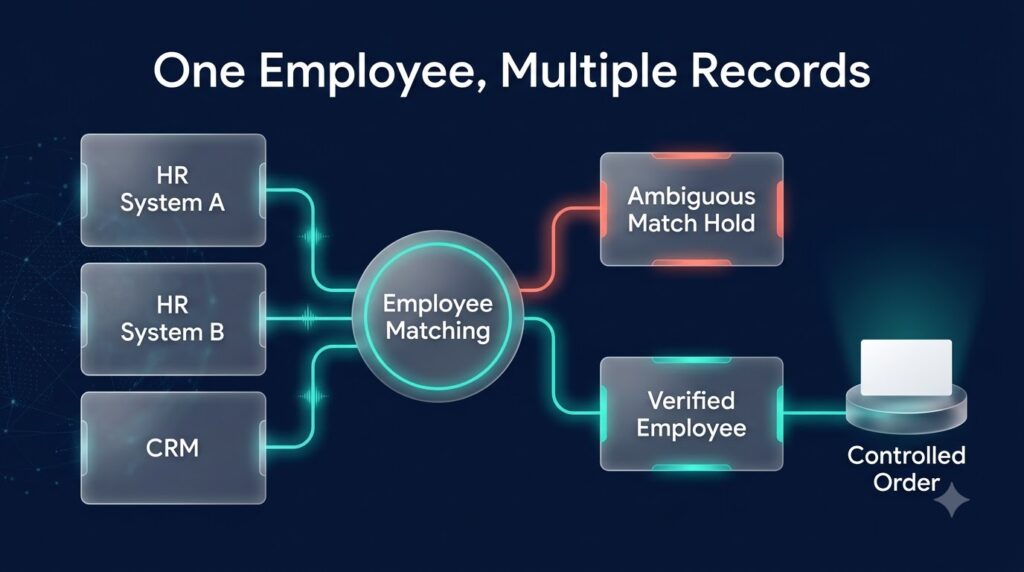
Resolve employees who appear in more than one system
Create a reliable way to associate source records with the intended employee. The design should explain how identifiers remain distinct across business units and how it handles legitimate multiple assignments. Avoid resolving duplicates through a familiar name alone. An incorrect match can attach another person’s approval, destination, or prior order to the request.
Consider an employee transferring between two divisions with different HR systems. The receiving division creates a record while the sending division still shows an active assignment. The ordering workflow should establish the intended entity and timing before it treats the two records as two purchasing opportunities. A second active record may reflect transition administration rather than a second need for cards.
In a standalone deployment, assign an administrator to verify the transfer and reconcile the portal profile. In an integrated deployment, demonstrate the matching rule, the ambiguous-match hold, and the correction process. Neither proposal should rely on silently deleting one record. Historical orders must remain attributable to the identity and entity that authorized them.
Separate employee changes from purchasing demand
A source update can make a request eligible for review without creating an immediate order. A manager change may alter an approval route. A legal-entity transfer may require different printed details. A CRM territory update may affect internal reporting only. Agree on the consequence of each covered change before deciding how frequently to transfer information.
Suppose HR changes an employee’s office location while CRM retains the previous territory assignment. The appropriate action depends on whether the printed address, delivery destination, or paying unit changes. Treat these as distinct fields with distinct decisions. Updating a delivery address should not silently rewrite the public office address, and a revised cost allocation should not automatically create replacement cards.
The buyer should see both a purchase outcome and a no-order outcome during evaluation. Closing a reviewed change without purchasing can be correct and useful. Include that administrative work in the baseline so that the business case captures the effort required to assess demand rather than counting only completed print orders.
Keep approval attached to the ordered specification
Record what the approver authorized, including the card content and the purchase details relevant to their decision. An employee may correct a phone number after content approval, or a coordinator may increase quantity after budget approval. The process should identify when those changes require another decision and who can make it.
A portal can retain this evidence through its supported approval and history functions. Verify that you can trace the final order to the approved version rather than assuming that a saved proof provides complete purchase authorization. If your team must maintain evidence externally, include the associated handling and retention in the cost estimate.
For the integrated option, ask what happens if source information changes between approval and submission. Reading the newest available value may create an order that differs from the approved request. Demonstrate how the platform preserves the authorized specification and handles a material revision. Confirm the actual BCM operations available for this process instead of assuming a particular endpoint or version-control feature.
Review BCM business card ordering governance
Prevent duplicate demand across entry points
Multiple request interfaces create a coordination problem. An employee may order through the portal while sales operations prepares a request for an event. HR may also initiate onboarding review. These are separate expressions of demand that may refer to the same intended purchase.
Agree on a way to identify the request purpose, intended employee, and related purchasing activity across the covered entry points. The design should distinguish an accidental duplicate from a legitimate additional quantity or a separate regional card. Automatically rejecting every similar request can be as disruptive as accepting every request without review.
In a demonstration, submit a portal request and an integration request for the same employee and purpose. Ask how the operator sees the relationship and resolves it before another order is released. Then test an uncertain response after submission. The recovery procedure should use available order evidence to determine what happened before repeating the purchase. Confirm which checks BCM supports and which belong in the integration or an administrator’s procedure.
Choose the right role for a shared integration layer
A shared integration service can be useful when several systems contribute to the same request. It may normalize permitted values, associate source identifiers, and route exceptions before calling a supported BCM operation. That is an architecture option to assess, not a requirement to build a large central platform before the first connection delivers value.
BCM’s integration roadmap recommends limiting duplication and preserving the authority of each contributing system. For this buying decision, ask whether the proposed connection can reuse existing enterprise integration services and support ownership. A new layer should have a clear purpose and a named operating team.
Compare this with the portal alternative honestly. A portal may require fewer technical components but more ongoing administrative reconciliation. An integration layer may reduce repeated handling but add monitoring, release management, and credential maintenance. Evaluate the combined workload. A technical team’s preference for automation should not substitute for evidence that the organization can operate it consistently.
Use a controlled fallback during connection outages
An enterprise may continue to receive legitimate requests while a source system or connection is unavailable. Decide whether requests can wait, whether previously verified information remains usable, and which exceptional orders may proceed with manual review. The policy should account for the freshness and sensitivity of the required information.
A fallback should preserve a record of the request and its approval. If staff use the portal during an outage, reconcile that activity before queued integration requests resume. Otherwise, the restored connection may interpret already handled demand as new work. Give the operator a way to identify these cases and a defined procedure for closing them.
Test return to normal operation as part of the pilot. Demonstrating that a connection resumes is insufficient if the organization cannot establish whether intervening requests were already ordered. The person authorizing recovery needs evidence of completed work, pending requests, and unresolved outcomes across the covered channels.
Keep production follow up and financial responsibility clear
BCM remains the contracted business card vendor in the proposed commercial arrangement. The enterprise should understand how accepted orders, production queries, delivery questions, and corrections are handled under that contract. Connecting multiple source systems should not create competing instructions to separate production parties.
For both deployment options, confirm the statuses available to authorized users and their meaning. Approval, accepted order, and shipment are different events. If the integration returns only selected statuses, specify the remaining follow-up route. A requester should receive the last verified position rather than an optimistic interpretation of a successful transfer.
Ask how a change is handled after order acceptance. A new HR record or corrected portal field does not by itself establish that production can be changed or cancelled. Demonstrate the supported intervention route and document practical limits. The buyer needs a named owner for the case in which a requested change arrives too late to alter the original order.
Calculate the cost of maintaining each model
Build the portal baseline from observed work. Include record maintenance, request checks, approvals administered outside the tool, duplicate investigation, and status inquiries. Add the effort required to reconcile employee transfers between systems. Separate these activities from printing and shipping so that the effect of integration can be evaluated independently.
For the API option, include initial implementation and recurring operational costs. Confirm whether source application access, integration infrastructure, monitoring, support, and future mapping changes are included. Ask how the estimate changes when a second business unit or source environment is added. A successful first connection does not prove that expansion will require no further work.
Use the same planning horizon and ordering assumptions for both options. Show expected administrative effort, support commitments, and unresolved assumptions alongside the commercial quote. Avoid presenting every minute saved as a cash saving unless the enterprise can explain how the released time will be used. Reduced interruptions and clearer ownership can still matter without being assigned an invented financial return.
Pilot one population with overlapping records
Choose a population that contains enough complexity to test the decision but remains small enough to investigate. Include employees who appear in HR and CRM, a coordinator who orders on behalf of others, and a known transfer between business units. Keep the initial product and approval scope narrow.
Run the same requests through the proposed operating procedures. Test an ordinary order, a source disagreement, an ambiguous employee match, a post-approval revision, and a duplicate request across channels. Include an outage fallback and the subsequent reconciliation. Record the final business outcome and the person who resolved each case.
Review handling time, corrections, unresolved cases, and support effort with the teams that will operate the deployment. A pilot succeeds when those teams can explain and repeat the process during absences, not only when the implementation specialist is present. Use the results to decide whether to remain with the portal, integrate one recurring workflow, or expand connections gradually.
Build the next phase with the enterprise integration roadmap
Questions for enterprise buyers
Can an ordering portal also use BCM API integrations?
A portal and an API connection can coexist in a proposed deployment. Confirm the actual supported configuration. The comparison here concerns the work required when source information is maintained manually versus supplied through a scoped connection.
Should every HR and CRM system connect directly to BCM?
No universal architecture is required. Evaluate the minimum connections needed for the selected population and decisions. A shared integration service may be appropriate where several sources must be reconciled, while a narrower use case may need a simpler design.
Does an API connection eliminate employee data conflicts?
No. A connection can apply agreed rules and expose exceptions, but the enterprise must decide which source owns each fact and who resolves disagreements. Missing ownership remains a process problem even when data transfer is automated.
When is the standalone portal a reasonable choice?
It can be appropriate when administrators can maintain accurate records, retain approvals, and manage follow-up without excessive handling. Measure those activities before investing in integration. Preserve a documented process so that the decision can be revisited as demand changes.
What should a BCM proposal specify?
Request the covered population, source environments, authorized fields, supported BCM operations, approval behavior, duplicate handling, fallback procedure, and operating responsibilities. Ask which elements are available, configurable, or require development. Do not infer a native or certified connector from a platform name.
Evaluate the portal and API options with BCM
Bring one ordinary request and one overlapping employee case to a BCM workflow assessment. Ask for comparable portal and API proposals using the same approval requirements and purchasing assumptions. The demonstration should show how the request reaches a clear decision, how the accepted order relates to that decision, and how the enterprise handles exceptions after launch.
Request pricing or schedule a demo with Business Card Manager to review your multi-system integration scope.