

Oracle NetSuite Business Card Ordering Integration For Cost Allocation and Financial Reconciliation
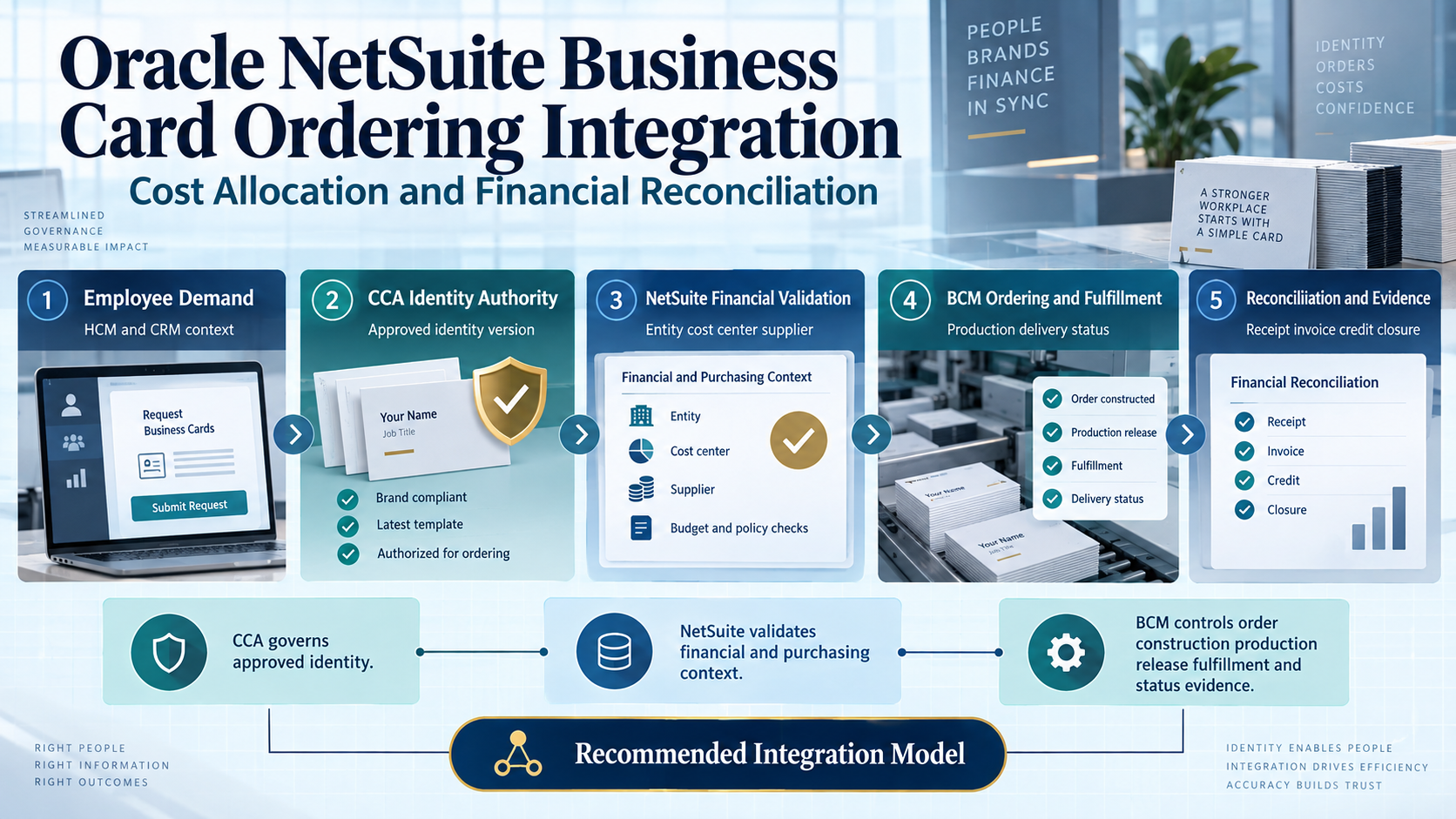
A governed integration model for employee demand, approved identity-controlled ordering, and traceable financial closure.
Oracle NetSuite can provide entity, location, cost center, purchasing, supplier, receipt, invoice, credit, and accounting context for business card transactions. CCA governs employee eligibility and the identity approved for print. BCM converts that approved specification into a controlled order and returns production, shipment, delivery, cancellation, and reprint evidence. A reliable integration links these records without allowing financial data to overwrite identity authority or a purchase transaction to bypass production controls.
NetSuite Connects Financial Control to Business Card Execution
Business card ordering creates a small transaction with an unusually broad operating footprint. A new hire, customer assignment, office move, executive appointment, conference, or approved reorder may create demand. The request then crosses employee data, public identity, brand, product configuration, purchasing, supplier production, delivery, receipt, invoice, and cost allocation. If each team records only its part, finance receives a charge without a complete explanation of what was authorized and delivered.
Oracle NetSuite can contribute the financial and operational structure needed to control that transaction. Depending on the customer environment and licensed capabilities, an integration may exchange subsidiaries, departments, classes, locations, accounts, projects, cost centers, vendors, purchase orders, item references, receipts, invoices, credits, and status data. BCM supplies the production and fulfillment detail that an ERP record normally does not contain.
The authority boundary must remain explicit. NetSuite governs accounting structure, purchasing records, supplier obligations, and financial posting. Color Card Administrator governs who may receive a card and what identity and presentation may be printed. Business Card Manager applies card, template, quantity, supplier, proof, release, delivery, and reorder controls. Integration connects these responsibilities; it does not merge them.
A Stable Transaction Chain Improves Reconciliation
A purchase order number alone cannot explain a business card outcome. The organization needs a stable relationship among the employee or approved recipient, request, authority decision, CCA identity version, BCM order, NetSuite purchase transaction, supplier acknowledgement, shipment, delivery, receipt, invoice, credit, and replacement. The correlation design should survive partial shipments, cancellations, reprints, supplier substitutions, consolidated invoices, and accounting adjustments.
BCM can create or retain the operational reference before production release. NetSuite can return the relevant purchasing and financial identifiers. Each subsequent event carries the shared correlation key and its native system identifier. Support teams can then locate the complete history without matching employee names, invoice descriptions, or delivery addresses manually.
Version control is equally important. If a title, quantity, entity, supplier, address, or price changes after approval, the integration must determine whether the existing authority still applies. Material changes may require a revised CCA decision, a changed purchase record, a new proof, or cancellation and replacement. The transaction history should show which version was ordered and which financial record settled it.
The Governed NetSuite and BCM Workflow
| Stage | Governed action | Required evidence |
| Demand and eligibility | HCM and CRM event establishes employee status and business need | Candidate request with stable identity correlation |
| Identity authority | CCA approves name, title, entity brand, language, contact details, and template | Versioned identity specification authorized for use |
| Financial validation | NetSuite supplies valid entity location cost object vendor and purchasing context | Order has an accountable commercial destination |
| Order construction | BCM applies product quantity proof, supplier shipping, and release controls | One executable order linked to approved identity |
| Fulfillment evidence | BCM and supplier return production shipment delivery cancellation and reprint status | Actual outcome remains visible and owned |
| Financial closure | NetSuite records receipt invoice credit allocation and posting | Authorized expected and actual results reconcile |
Financial Dimensions Must Be Valid Before Release
Large organizations often require more than a general ledger account. The correct combination may depend on subsidiary, legal entity, department, class, location, project, customer program, campaign, or another approved cost object. BCM should receive only the validated codes needed for the order and return them with the transaction reference. Free text should not substitute for controlled values when NetSuite maintains the authoritative dimension.
The business card workflow should validate effective dates and permitted combinations. A cost center may be active but unavailable to the selected subsidiary. A location may be valid for accounting but inconsistent with the employee or delivery destination. A project may have closed after the request began. BOC or the configured integration logic should stop the order, identify the failing rule, and route the correction to the owner rather than silently choosing a default.
Financial validation cannot authorize printed identity. An employee can have a valid department and cost center while the requested title or brand remains unapproved. CCA must resolve that identity decision before BCM freezes the production version.
Item and Catalog Mapping Protects the Buying Record
The integration needs an agreed relationship between BCM card configurations and NetSuite items or purchasing categories. A standard card may map to a catalog item, while finish, language, region, supplier, quantity band, rush service, or delivery method affects the line detail or price. Mapping should be governed centrally and tested for every supported market.
The purchasing record must be specific enough to support approval and reconciliation without reproducing the complete artwork or sensitive employee profile. Useful line data can include the BCM order reference, approved item, quantity, unit price, supplier, delivery charge, tax treatment, requested date, cost allocation, and secure reference to the production record. NetSuite should not become a repository for unrestricted print files or unnecessary personal data.
When a catalog item, price, contract, or supplier becomes invalid, BCM should block or reroute the transaction according to policy. Substitution requires a defined decision because a different supplier, material, finish, delivery route, or price can change both the produced result and the financial commitment.
Purchase Orders and Production Release Need Separate Controls
Some organizations create a purchase order before each order. Others use blanket orders, consolidated purchasing, procurement cards, or approved invoice models. The CRM integration should support the customer’s chosen control without treating the presence of a purchase record as complete production authority.
BCM should release only when the required identity, product, quantity, supplier, financial, approval, and timing conditions are valid for the same version. If NetSuite approval is pending, the BCM order remains prepared but unreleased. When financial approval is rejected, expired, or changed, BCM blocks production and records the reason. If production has already started, the workflow routes the case to an owner who can decide the commercial and operational disposition.
This separation also prevents the inverse problem. A valid CCA identity does not mean that funding, supplier, quantity, or delivery conditions are approved. Identity authority and purchasing authority meet at the production-release checkpoint, where BCM confirms both.
Receipts, Invoices, Credits, and Reprints Need Operational Evidence
A supplier invoice can match a purchase order and still represent an incomplete or incorrect outcome. Cards may arrive late, at the wrong location, with a production defect, or after the employee changed roles. BCM provides the operational evidence needed to interpret the financial transaction. Shipment and delivery status can support receipt, while exceptions can hold or qualify the accounting step according to policy.
The design should define whether receipts are created automatically, proposed for review, or entered by an accountable user. Delivery confirmation may be sufficient for standard shipments, while high-value, regulated, or executive orders may require a named receipt. Partial shipments need partial receipt logic. Cancellations, reprints, and credits must reference the original order and reason so finance can distinguish supplier failure from an authorized new request.
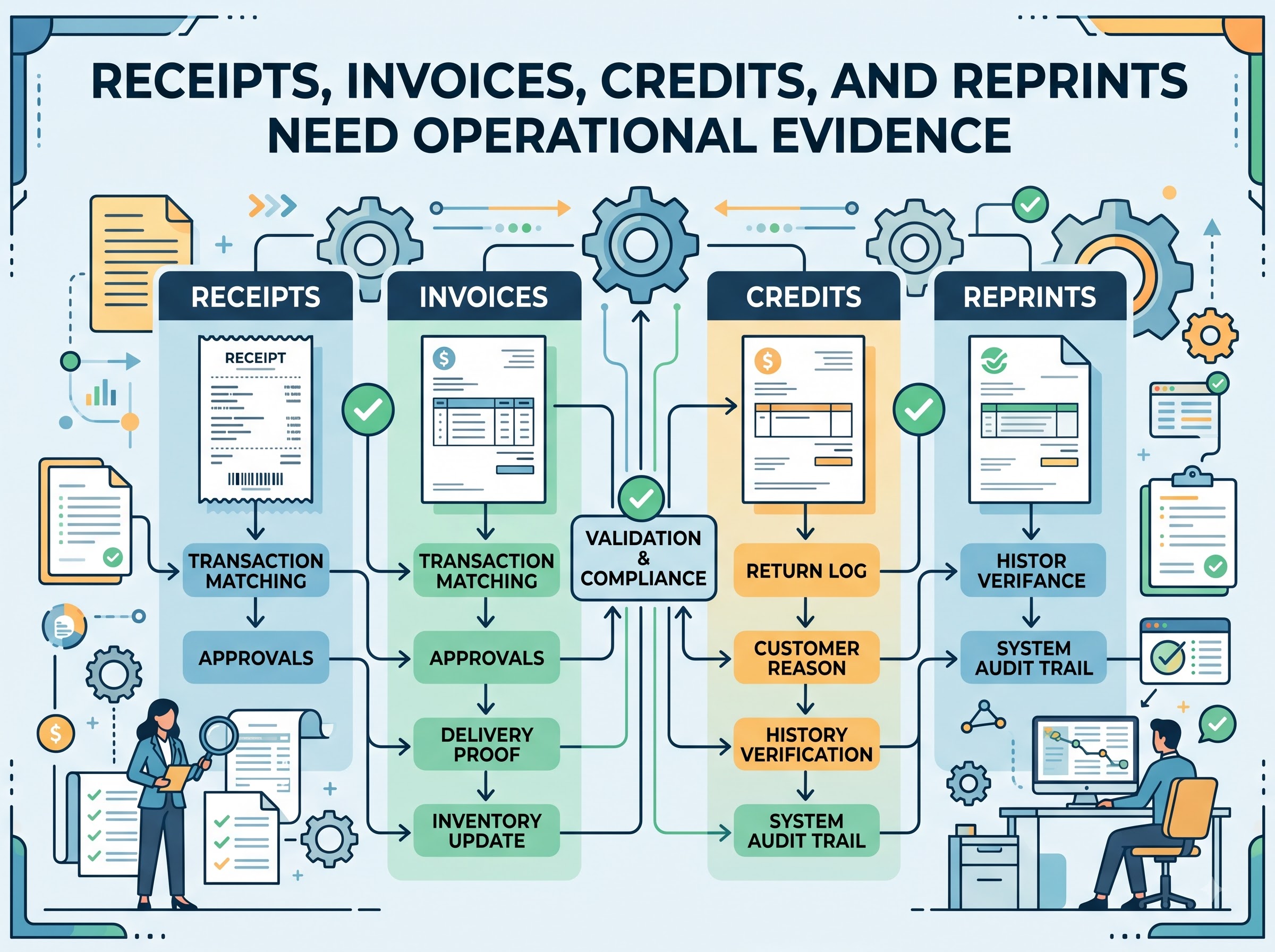
Invoice matching should compare supplier, entity, item, quantity, price, tax, freight, currency, purchase reference, receipt, and BCM outcome. Variances receive an owner and a permitted resolution. Closure occurs only when the operational and financial records agree, or an authorized disposition explains the difference.
API Design Must Preserve Security and Recovery
The implementation may use NetSuite REST web services, SuiteTalk capabilities, integration middleware, scheduled exchanges, or another approved interface. Exact services, authentication, permissions, records, fields, limits, and entitlements must be confirmed for the customer account and release. This article describes a recommended integration model rather than a released native BCM connector.
Use a dedicated integration identity with minimum permissions, protected credentials, environment separation, field-level data minimization, monitored failures, and documented rotation. Logs should emphasize correlation identifiers, status, error category, and retry history instead of complete employee or financial payloads. Sensitive identity, banking, tax, credential, and artwork data should remain outside the integration unless the stated purpose requires it.
Reliable processing must handle duplicate events, timeouts, throttling, unavailable systems, delayed updates, and responses received out of order. Idempotency keys and operational reconciliation jobs prevent duplicate purchase records and orders. Failed transactions belong in an owned queue with enough context to correct the cause and resume from the controlled checkpoint.
Spend Reporting Needs the Reason Behind the Cost
NetSuite can show expenditure by subsidiary, account, department, class, location, project, vendor, period, and other configured dimensions. BCM can add order purpose, card family, requester type, quantity, rush status, production lead time, delivery outcome, cancellation, reprint, and exception cause. Together, these records explain both the amount and the operational reason.
Higher business card spend may reflect growth, acquisitions, new offices, customer events, or workforce changes. Avoidable spend may come from duplicate requests, obsolete identity data, invalid templates, excess quantity, off-contract suppliers, delivery failure, production defects, or late cancellation. Reporting should separate legitimate demand from control failure so the responsible team can act on the cause.
Useful measures include straight-through processing, approval time, order correction, duplicate prevention, contracted-supplier use, price variance, delivery performance, missing receipts, invoice exceptions, credits, reprints, and transactions closed with complete evidence.
Buyer Intent Bridge for NetSuite Integration
Enterprises evaluating an enterprise business card integrations platform should ask how it exchanges subsidiaries, dimensions, items, vendors, purchasing documents, receipts, invoices, credits, and status with NetSuite. They should also test correlation, data minimization, version control, duplicate prevention, partial fulfillment, supplier changes, exception handling, reconciliation, and recovery after an outage.
The evaluation should preserve each system’s role. CCA governs eligibility and public identity. BCM constructs and releases the approved production order. NetSuite governs financial structure, purchasing records, and accounting evidence. Buyers should request a field map, event model, authority matrix, security design, retention rules, failure procedures, and proof that a financial transaction cannot overwrite identity or release an unapproved production version.
Implementation Priorities
Begin with one subsidiary, standard card family, supplier, currency, financial-dimension pattern, purchase model, delivery method, and invoice process. Define authoritative systems, identifiers, item mappings, approval states, production conditions, receipt rules, invoice references, cancellation treatment, access controls, logging, retention, and exception ownership.
Test new hires, changes to title and location, invalid dimensions, closed projects, inactive vendors, expired items, high quantities, rejected approvals, purchase-order delays, supplier substitution, duplicate events, partial shipments, delivery failures, cancellations, credits, reprints, and changes before and after production release. Expand after both standard and exception paths produce traceable operational and financial evidence.
Frequently Asked Questions
Can NetSuite initiate a business card order?
A configured workflow can use an approved employee, purchasing, or operational event to prepare a request. CCA must still authorize identity, and BCM must validate and release the matching production order.
Does a NetSuite purchase order authorize production?
Not by itself. The purchase order can establish commercial authority, but BCM should release only when the identity, item, quantity, supplier, timing, delivery, and approval conditions are valid for the same version.
How does NetSuite improve cost allocation?
NetSuite can supply controlled subsidiary, department, class, location, project, account, and vendor context. BCM returns the order and fulfillment evidence that explains the charge.
Does BCM provide a native NetSuite connector?
This article describes a recommended integration model. Feasibility depends on available NetSuite interfaces, authentication, permissions, licenses, transaction design, supplier capabilities, and the configured BCM and CCA environment.
Connect NetSuite Financial Control to Governed Business Card Ordering
Connect cost allocation and financial reconciliation to the order that produced the cost. Explore how Business Card Manager can connect approved employee identity, NetSuite financial context, purchasing records, supplier execution, delivery evidence, and accounting closure. Request a BCM demonstration and NetSuite integration fit discussion at https://www.businesscardmanager.com/