

Business Card Ordering During an Enterprise Rebrand
Evaluate BCM API workflows against manual replacement campaigns during an enterprise rebrand. Compare approved template mapping, employee waves, existing orders, delivery, and continuing reorder controls.
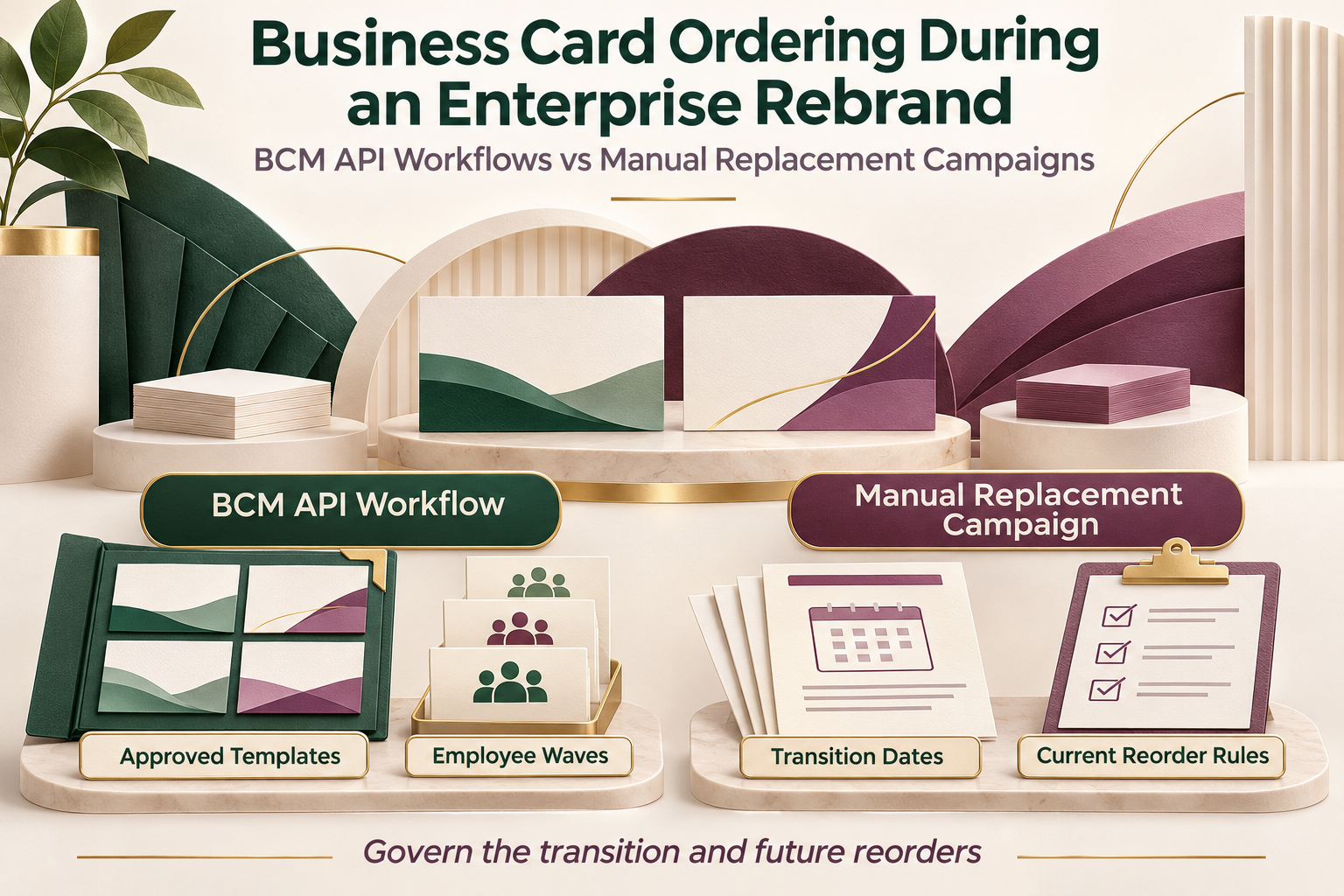
BCM (Business Card Manager) is the enterprise business card ordering management system and contracted business card vendor that converts authorized specifications into controlled orders. Business card ordering during an enterprise rebrand requires more than replacing a logo in an order form. The enterprise must decide which employees move to which approved card versions, when those versions may be used, and what happens to requests already in progress.
The buying question is whether a scoped BCM API workflow can coordinate those decisions more reliably than a manual replacement campaign. Integration may reduce repeated entry and improve the visibility of unresolved work. It does not determine brand authority, authorize every employee to receive replacements, or establish that all existing orders can be cancelled when the new identity launches.
This article compares the two approaches from approved rebrand specifications through employee receipt and continuing reorders. It addresses employee eligibility, template mapping, transition dates, existing orders, and exception ownership. The proposed controls are evaluation requirements. Confirm actual BCM operations, customer application access, production arrangements, and delivery scope before treating any proposed behavior as an available product feature.
Define What the Rebrand Changes for Business Cards
A rebrand can affect the logo, company presentation, typography, public titles, contact details, or approved card families. Some organizations may also change legal entities or office arrangements, while others change only the visual identity. List the actual changes before assembling a replacement population.
Distinguish a brand decision from a workforce update. An employee’s internal department may remain unchanged while the approved card design changes. A legal-entity movement may require additional identity review even when the logo remains familiar. The ordering workflow needs an explicit specification rather than an assumption that every old card maps to one new template.
BCM’s implementation guidance describes ordering as an operating model connecting employee information, identity authority, brand rules, approvals, production, and delivery. Use that model to establish the decisions required for the rebrand. A campaign should begin with approved requirements and responsible owners, not a file of names followed by an urgent request to print.
Read the enterprise BCM implementation guide
Compare Manual Coordination With a Scoped API Workflow
A manual replacement campaign can use a controlled employee file, approved artwork references, explicit authorization, and a coordinator who tracks each outcome. It may be appropriate for a limited transition with few card families. The work grows when the population changes, several teams circulate revised files, and administrators must reconcile old and new order references.
A connected workflow may apply approved mapping rules to source information and pass authorized requests to BCM through supported operations. The customer application or middleware may coordinate the campaign. Do not assume a native rebrand migration feature, a bulk endpoint, or an all-or-nothing transaction merely because the proposal uses the term automated rollout.
| Buying criterion | Scoped BCM API workflow | Controlled manual campaign |
|---|---|---|
| Population | Apply approved eligibility and wave rules | Maintain the authorized employee file |
| Template mapping | Use agreed source and identity rules | Verify each approved card family |
| Transition dates | Track permitted actions by stage | Maintain milestones and release instructions |
| Existing orders | Correlate earlier and replacement work | Review activity before purchasing |
| Continuing reorders | Test current mappings across entry points | Update forms and coordinator instructions |
| Recovery | Reconcile individual results before retry | Retain references and investigate gaps |
Compare both approaches using the same employees, card families, authorization rules, and delivery expectations. Include a person who does not require an immediate replacement, an employee with an unresolved title, and a purchase already accepted under the previous identity. The demonstration should explain what happens to each case rather than showing only the successful new order.
Establish the Authority for the New Public Identity
Brand approval of the visual system does not automatically settle every printed employee field. A public title, translated credential, entity name, office address, or language variation may require decisions from different owners. Establish which values are locked and which can vary within the approved design.
Where Color Card Administrator is deployed, CCA governs the approved public identity and related exceptions. BCM acts as the conversion and execution system for the authorized business card purchase. The customer retains ownership of its internal workforce, brand, purchasing, and information policies. Keep those responsibilities visible in the rebrand approval process.
Require an approved reference for each relevant card family and variation. A coordinator should not need to infer whether an older subsidiary name remains permitted or whether a regional title can be carried into the new design. Send unresolved identity questions to the responsible authority before they become production corrections.
Review BCM business card ordering governance
Map Employees to Permitted Card Versions
Start with the rules that select the card family for each employee. Relevant inputs may include legal entity, brand assignment, approved language, office, and customer-facing role. Define the authoritative source and correction owner for each input rather than accepting whichever value appears in the campaign file.
Use a stable employee reference to connect workforce records with the beneficiary and request history. A name alone cannot reliably distinguish employees with similar names or reconcile a person whose display name changes during the program. Retain enough source context to explain why a particular template was selected.
BCM’s HCM and CRM integration model separates workforce facts, limited commercial context, approved identity authority, and order execution. Apply that separation to the rebrand mapping. Source data can help determine the employee’s context, while the approved policy determines the card they may use. A new logo file should not override that decision through an uncontrolled default.
Explore the BCM HCM and CRM integration model
Decide Who Needs Replacement Cards and When
A rebrand does not necessarily require an identical replacement purchase for every employee. The enterprise may prioritize employees with an immediate external-facing need, use a phased approach, or permit an approved transition at the next reorder. The applicable brand policy should establish the treatment, including whether old stock may remain in use.
Collect the information needed to apply that policy without inventing an inventory record the enterprise does not maintain. Employee confirmation may be necessary to assess existing cards or upcoming business requirements. A workforce export can identify active employees without establishing that each person needs the same quantity.
Document exclusions and deferred cases. An employee scheduled for a later wave should not appear as an unexplained failure in a campaign report. Conversely, excluding someone from the first purchase should not permanently remove them from the permitted ordering process. Keep the replacement decision distinct from continuing employee eligibility.
Separate Announcement Dates From Ordering and Use Dates
A public announcement date, the date artwork becomes orderable, the date production may be released, and the date employees may use the new cards can differ. Capture the relevant dates and identify who can authorize a change. A single launch date field may conceal several business decisions.
Confirm production and delivery arrangements with BCM before setting internal milestones. A requested rollout date is not a confirmed service commitment. Where early preparation or purchasing is permitted, establish how the enterprise handles the new identity before its authorized use date, including access to proofs and campaign materials.
Test a launch that is postponed after some requests are prepared. The operator should identify the affected work and follow the agreed next step for its actual stage. Do not assume the API can automatically hold, cancel, or recover every transaction. Available intervention routes and commercial consequences need confirmation for accepted or in-production orders.
Review Existing Requests Before Releasing Replacements
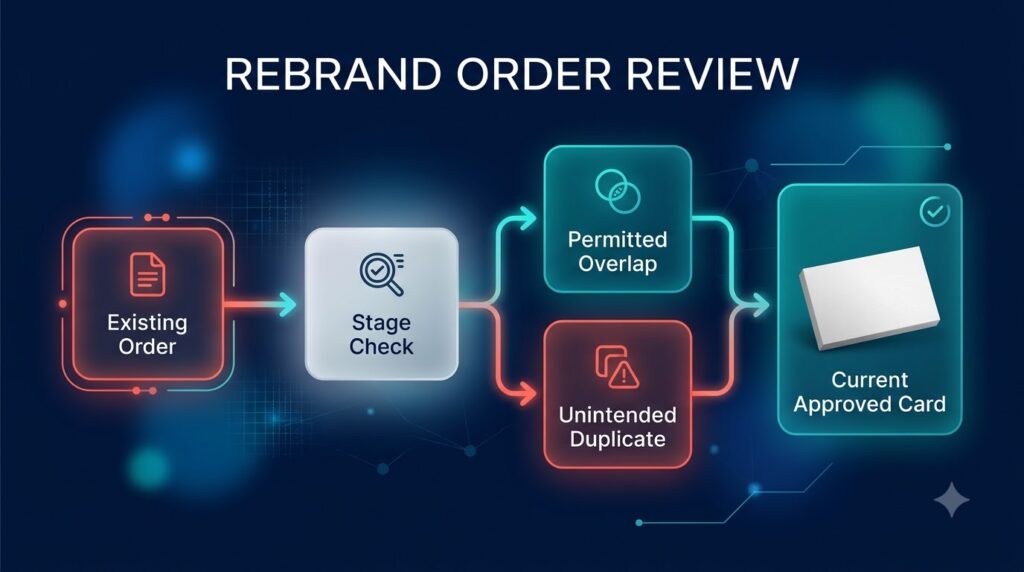
Employees may have ordinary reorders, event-related requests, or assistant-submitted purchases underway when the rebrand begins. Determine whether those transactions satisfy a continuing need, require revalidation, or need an operational inquiry. Simply submitting a replacement campaign can create additional purchases without resolving the earlier ones.
Retain relationships between the campaign, employee, existing request, and any new authorized order. Establish how a coordinator identifies the same business need across channels. Two card versions for one employee may be legitimate during an approved transition, so the process should distinguish permitted overlap from an unintended duplicate.
For the manual approach, require a check of relevant activity before purchasing. For the API approach, demonstrate the supported references and available checks used to reconcile existing work. If an order’s submission result is uncertain, resolve that outcome through supported evidence or BCM assistance before creating another purchase under the new campaign.
Revalidate Approved Content When the Specification Changes
A proof approved before the final identity decision may no longer represent the permitted card. Determine which changes invalidate the earlier review and who must authorize the revised specification. A quantity or destination change may affect purchasing approval even when the artwork remains unchanged.
Preserve the reviewed version or another reliable reference with the decision. Updating the current template or employee profile should not make an earlier order appear to have been approved under the new identity. The enterprise should be able to establish what was authorized and what actually proceeded.
Include a demonstration in which a template changes after approval but before submission. The operator should see which version is current and whether release remains permitted. For an order already in production, follow the supported service inquiry route. A saved template update does not prove that the physical transaction changed, and a replacement remains a separately authorized purchase.
Prevent Retired Templates From Reappearing in Later Reorders
The initial replacement wave is only part of the transition. Employees and assistants may return through saved links, previous order history, or familiar request instructions. Establish how the permitted ordering routes select the current card family and how exceptions to the new policy are handled.
Identify which customer applications and BCM configurations need changes. Confirm the actual mechanism available to restrict obsolete selections or guide the requester to a current specification. Do not assume that modifying one integration mapping updates every manual form, portal route, or historical reorder action.
Test a reorder initiated from an earlier purchase after the transition date. The desired result is the currently authorized specification or an explicit exception for review. Preserve historical evidence of the earlier card while preventing that record from silently authorizing new production of a version the enterprise has retired.
Phase the Rollout Around Operational Readiness
A staged program may separate employee groups by approved need, card family, region, or receiving arrangement. Define the reason for each wave and the evidence required before it proceeds. Avoid using a convenient file size or application grouping as a substitute for the enterprise’s transition policy.
Decide how incomplete records affect the wave. Independent requests may be able to proceed while a title exception remains assigned to its owner. A coordinated launch may require a common release decision. Make that choice explicit so that one unresolved record neither blocks unrelated work by accident nor disappears from the program.
Require an individual outcome for each intended request. A campaign count should distinguish prepared work, exclusions, accepted orders, and unresolved submissions under agreed definitions. If the connection fails during processing, the team must know which cases can safely resume and which require reconciliation before any retry.
Plan Delivery and Employee Communication Together
The transition is incomplete for an employee who has an accepted order but cannot obtain the new cards. Define the supported receiving arrangement and the owner of internal distribution. A shipment delivered to a shared office may still need allocation before the beneficiary receives it.
Keep the printed office address separate from the shipping destination. A rebrand can change the public identity without changing the receiving location, or require a new destination without altering the artwork. Collect current confirmation where needed and limit private delivery information to the authorized audience.
Tell employees what action is required, when they may use the new cards, and how to report a problem. Avoid equating a technical submission notification with confirmed production or receipt. If a deadline cannot be met under the available service, route the case to the program owner for a verified decision rather than offering an unsupported arrival promise.
Scope the Workforce and Service Connections Deliberately
Workday, SAP SuccessFactors, Oracle HCM, ADP, UKG, or Dayforce may contribute employee and organizational facts. Microsoft Entra ID may supply approved directory attributes. Dynamics 365 or HubSpot may provide limited team context, while ServiceNow may host confirmation and service requests. Establish the actual responsibility of each application in the customer environment.
Define the minimum data required to assess the population, select the approved specification, route authorization, and correlate orders. Exclude unrelated HR and CRM information. Confirm customer access and supported BCM operations before specifying how the campaign will run or how status will return to the originating workflow.
A named platform does not establish a native connector, automatic template migration, or synchronized global release. Where Business Ops Center is deployed for cross-system oversight, define its role in correlation and unresolved work. Preserve CCA’s identity authority and BCM’s ordering execution responsibility so that each exception has an identifiable decision or service owner.
Explore BCM integration options
Pilot the Transition and Measure Continuing Control
Use a representative population and approved testing arrangements before authorizing a major replacement campaign. Include multiple card families, an employee deferred to a later wave, a material correction after approval, an existing order, and a late reorder from the previous identity. Test recovery from an interrupted submission as well as ordinary processing.
Measure active coordinator effort, first-pass mapping accuracy, correction work, unresolved orders, and delivery inquiries. Compare those results with the controlled manual process. Include the work required to maintain mappings, monitor the connection, and resolve exceptions after the initial campaign ends.
BCM’s implementation guidance emphasizes an explicit operating model and baseline before rollout. Use the pilot to confirm who owns each decision and whether the team can sustain the new ordering rules. A successful transition should leave continuing reorders under control, with retained historical evidence and an owned route for exceptions, rather than merely recording that the first replacement file was submitted.
Questions About Business Card Ordering During a Rebrand
Should every employee receive replacement cards immediately?
Use the enterprise’s approved transition policy. Business need, existing stock information, eligibility, and phased rollout rules may justify different treatment. A rebrand announcement alone does not establish identical purchasing authority for every employee.
Does BCM API integration decide which brand an employee uses?
The approved identity and mapping policy makes that decision. A scoped integration can apply authorized rules using available source information and supported BCM operations. Unresolved identity questions still need an accountable owner.
Can updating a template change orders already in production?
Do not assume that behavior. Establish the actual order position and follow the supported intervention route with BCM. A saved template update is separate from a confirmed change to a physical transaction.
How should old templates be handled for later reorders?
Define the permitted transition date and review every relevant ordering route. Confirm the configuration or customer-side controls that prevent unauthorized reuse while retaining historical order evidence.
What should buyers compare between API and manual campaigns?
Use the same population, approved specifications, dates, and service scope. Compare mapping accuracy, authorization evidence, existing-order handling, individual outcomes, and ongoing support, including reorders after the campaign.
Request a BCM Rebrand Ordering Assessment
Bring your approved card families, proposed employee waves, transition dates, and examples of orders already underway. Ask BCM to demonstrate the supported ordering path and identify where customer applications apply mapping, authorization, and reconciliation rules. Compare that design with a controlled manual campaign using the same service expectations. Establish how continuing reorders will use the current approved identity and who owns exceptions before expanding the rollout.
Request pricing or schedule a demo with Business Card Manager to review your enterprise rebrand ordering integration scope.